Procurement with the CO₂ Performance Ladder 4.0: from policy to results
By using the CO₂ Performance Ladder as a Best Price-Quality Ratio (BPQR) award criterion in a tender, you encourage CO₂ reduction during the delivery of the project. From January 2027 it will be mandatory to use version 4.0 of the CO₂ Performance Ladder in procurement. In this blog you can read how procurement with the Ladder works and the four steps to implement the Ladder. In addition, Rijkswaterstaat (the Dutch agency for roads and waterways) shares tips for using the Ladder as a procurement instrument.
Activities carried out as a result of procurement accounts for 15 per cent of global CO₂ emissions. The emissions released during the delivery of public procurement are many times higher than the emissions governments produce within their own organisations. By encouraging contractors to reduce their emissions and rewarding this in a contract, you as a contracting authority can make a big impact and contribute to achieving the Paris Climate Agreement goals.
Procurement with the Ladder leads to substantial emission reductions
Using the CO₂ Performance Ladder as a BPQR award criterion is one of the ways to do this. Research by Utrecht University has shown that construction projects procured with the Ladder emitted considerably less CO₂. The reduction was particularly large when a project was awarded to a party certified at the highest Level 5 – in version 3.1 – of the Ladder.
Stimulating the market and rewarding frontrunners
More than 300 contracting authorities in the Netherlands, Belgium and other European countries currently use the CO₂ Performance Ladder as a procurement instrument. By using the Ladder in procurement, you encourage the market to get moving and reward frontrunners for their extra emissions reduction efforts.
Procurement with the CO₂ Performance Ladder 4.0
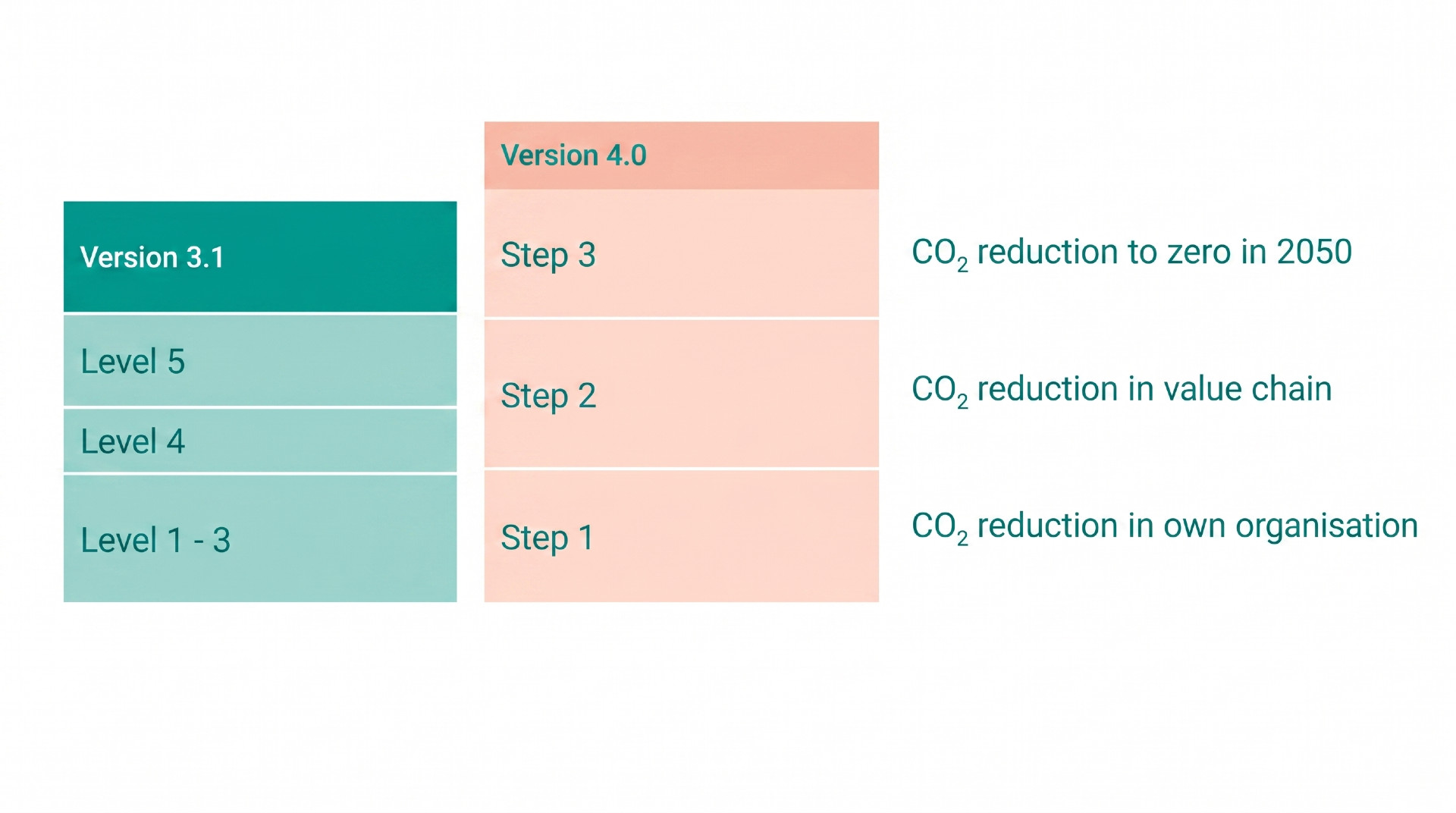
Compared with version 3.1, little has changed in version 4.0 in terms of how the Ladder is used in procurement. The main difference is the move from five Levels to three Steps. This means companies can now register at three CO₂ ambition levels – each with an associated award advantage – rather than five.
Transition arrangement to Ladder 4.0
From January 2027, contracting authorities are required to use version 4.0 in a procurement with the Ladder. Until then you may already use 4.0 in a procurement, but only if the market is ready for it. In concrete terms, this means that a large proportion of the companies in the sector are already certified to version 4.0 or are in the process of obtaining certification to this version.
You can read more about the transition arrangement for procurement with version 4.0 in this article.
Procurement guide CO₂ Performance Ladder 4.0
To support contracting authorities in using the Ladder as an award criterion, SKAO has published the Procurement Guide. Among other things, this document contains a concrete step-by-step plan, sample texts for tender documents & contracts, and an explanation of the CO₂ ambition levels that allow tenderers to distinguish themselves.
Procurement with Ladder 4.0 in four steps
Here is how to use the CO₂ Performance Ladder 4.0 award criterion in a procurement in four steps:
Step 1: include the CO₂ Performance Ladder as a BPQR award criterion
The first step is to include the CO₂ Performance Ladder as a BPQR award criterion in your tender documents. In the text you state, among other things, the three CO₂ ambition levels together with the related set, such as gaining insight into energy consumption and emissions.
For each CO₂ ambition level you make clear what advantage the tendering party enjoys. This could be, for example, a notional discount on the tender price or points. As a contracting authority you are free to choose which method you use and how high the award advantage is.
You also state in the tender documents how the tendering party can demonstrate that it meets the requirements (with a project statement or a CO₂ Performance Ladder certificate), the period within which that proof must be provided (usually one year) and the sanction if the performing party does not meet the agreed CO₂ ambition level within the set period (usually a fine).
“By using the CO₂ Performance Ladder as an award criterion, you reward organisations based on their ambitions and the impact they make. If you set a Ladder certificate only as a requirement, there is a strong chance that organisations will remain at Step 1. Using the Ladder as an award criteria rewards organisations that achieve even more impact.”
Thijs Wentink, Project Officer Procurement SKAO
Step 2: companies register with a CO₂ ambition level
The next step is for companies to submit their bids. In doing so, they indicate at which CO₂ ambition level they want to carry out the project or contract, and how they intend to demonstrate their compliance. This can be done in two ways:
With a project statement, with which a company demonstrates that it meets the requirements of the agreed CO₂ ambition level on a project-specific basis.
With a CO₂ Performance Ladder certificate whose Step corresponds to the submitted CO₂ ambition level. The CO₂ Performance Ladder certificate is proof of certification according to the CO₂ Performance Ladder 4.0 Handbook. With it, the tenderer demonstrates that the entire organisation acts in a CO₂-conscious way, including in the projects the organisation carries out.
When registering, a party indicates which independent certification body will carry out the audit. At the time of registration, a company does not yet need to hold a CO₂ Performance Ladder certificate.
NB: Companies are not obliged to register at a CO₂ ambition level.
Step 3: award the contract on the basis of the BPQR award criterion
Once you have received all tenders, you assess them on the basis of price, the CO₂ Performance Ladder award criterion and any additional criteria. This produces a best price-quality ratio. At the moment of award, the period begins within which the contractor must demonstrate that it meets the agreed CO₂ ambition level.
Step 4: the contractor carries out the contract at the agreed CO₂ ambition level
The final step is for the contractor to carry out the project at the agreed CO₂ ambition level. Via the project overview in My CO₂ Performance Ladder, the contractor gives the client insight into the project plan, the measures, the CO₂ and energy footprint and the progress of the project. These insights in turn form the basis for conversations about possible opportunities and how to seize them.
“When you procure with the Ladder for the first time, I recommend doing so step by step. Start with a selection of projects based on, for example, a certain project value or a category with the greatest CO₂ impact. Expand that to more projects and categories later.”
Thijs Wentink, Project Officer Procurement SKAO
Procurement with the CO₂ Performance Ladder: 3 tips from Rijkswaterstaat
In 2012, Rijkswaterstaat was one of the first government organisations to use the CO₂ Performance Ladder as an award criterion in tenders. From 1 July 2026, RWS will do so using CO₂ Performance Ladder version 4.0. Gerwin Schweitzer, adviser on climate-neutral and circular procurement at Rijkswaterstaat, gives three tips for using the CO₂ Performance Ladder as a BPQR criterion.
Tip 1: Announce a tender with the Ladder well in advance
“When you decide to use the Ladder as an award criterion, it is wise to announce this to the market well in advance. At RWS we keep to six months as a minimum. By communicating early, companies that want to tender for the contract have enough time to become certified at organisation level [if they wish].”
Tip 2: Be consistent in which procurement domain you apply the Ladder
“At RWS we apply the Ladder as standard in procurements for infrastructure, but also, for example, for the purchasing of services. By using the CO₂ Performance Ladder consistently within a procurement domain, companies know that they will be rewarded for their CO₂ ambitions in the future as well, and are more willing to make the investment for Ladder certification.”
Tip 3: Use the Procurement Guide as a guideline in contract models
“Although every procurement is different in substance and we have our own contract models at RWS, for the CO₂ Performance Ladder award criterion we follow the texts of the Procurement Guide 4.0 as much as possible. We then only need to specify the award advantage per Step, the sanction period and the sanction provision. We apply 2, 4 or 6 per cent award advantage, a period of one year and a penalty of 1.5 times the award advantage received.”
The most important questions about this topic are addressed in the FAQ below. If you have more questions, please contact us.
FAQ Procurement
Why would I use the CO₂ Performance Ladder in procurement?
The CO₂ Performance Ladder helps contracting authorities encourage CO₂ reduction during project delivery. Rather than including sustainability only as a requirement, tenderers are rewarded for their ambition and approach to CO₂ reduction.
This creates a positive incentive for market parties to invest in energy savings, emission reduction and innovation.
What does procurement with the CO₂ Performance Ladder ultimately deliver?
Experience shows that the CO₂ Performance Ladder leads to measurable emission reductions, greater attention to CO₂ reduction during projects, innovation in delivery, and better collaboration between contracting authorities and contractors. Over the longer term, this contributes to structural sustainability across the market. In this way, the Ladder delivers benefits not only for individual projects, but also supports the wider climate transition within sectors.
How does the CO₂ Performance Ladder relate to sustainable procurement?
The CO₂ Performance Ladder is a tool for putting sustainable procurement policy into practice. Ideally, it forms part of a broader strategy in which an organisation sets climate goals, establishes reduction targets and applies sustainable procurement systematically. This creates a consistent approach to the market and gives suppliers clarity about the contracting authority’s expectations.
How can I tender with the CO₂ Performance Ladder?
The CO₂ Peformance Ladder as a tendering instrument consists of a BPKV criterion CO₂ Peformance Ladder that can serve as the basis for an award advantage in a tender. Procurement Guide 3.1 describes how this criterion can be used. This guide also contains the text of the criterion. Read more on the procurement page with the CO₂ Performance Ladder.
Also read this article about EU procurement legislation and the CO₂ Performance Ladder.
Which contracting authorities use the Ladder in procurement procedures?
There are more than 8,000 organisations with a CO₂ Performance Ladder certificate, and over 300 contracting authorities in the Netherlands and, among others, in Belgium, Ireland, France, the UK, Germany and Portugal use the CO₂ Performance Ladder in procurement. These include national government bodies, municipalities, water authorities and provinces. For an overview of these contracting authorities, see the Participants page.
Which projects benefit most from the CO₂ Performance Ladder?
The CO₂ Performance Ladder comes into its own on projects where the contractor has real influence over CO₂ emissions during delivery. This applies, for example, to infrastructure projects, construction and maintenance projects, civil works, energy projects and services with a substantial climate impact. The greatest added value arises when the contractor can make choices during delivery that lead to demonstrable CO₂ reduction.
Can I also use the CO₂ Performance Ladder as a suitability requirement or selection criterion?
The CO₂ Performance Ladder is not suitable as an eligibility requirement or selection criterion.
There are several reasons for this:
– Implementing the CO₂ Performance Ladder within an organisation takes time and effort. In most situations, it will be disproportionate to require an organisation, prior to tendering for a specific project, to certify the entire organisation. Such a requirement is not reasonable for a project that will constitute only a (small) part of the organisation’s turnover. From a procurement law perspective, there is then insufficient connection between the requirement and the subject matter of the contract. Also for this reason, such a requirement is not allowed as a suitability criterion or selection criterion.
– Using a certificate as an eligibility criterion or selection criterion means that parties without the required (level of the) certificate cannot compete or have less chance of being selected. This discriminates against foreign parties or small companies, for example. Procurement law does not allow this.
This principle applies to all tenders: European, national, and private treaty. For small contracts, such a suitability requirement is just as discriminatory. For private contracts, no further selection takes place anyway.
The CO₂ Performance Ladder is a certification at organisational level, but don’t requirements in a tender need to be linked to the contract/project?
From a legal perspective, requirements in tenders must always be linked to the subject of the contract. A CO₂ Performance Ladder certificate demonstrates that an organisation operates in line with the requirements of the CO₂ Performance Ladder Handbook and works in a structurally CO₂-conscious way. This applies to the entire organisation, including the projects it carries out.
When the CO₂ Performance Ladder is applied in a tender, the focus is therefore always on the project. The award criterion CO₂ Performance Ladder sets requirements for the execution of the specific project, at various CO₂ ambition levels. These project requirements are detailed in the Procurement Guide CO₂ Performance Ladder 4.0. The CO₂ ambition levels with project-level requirements correspond to the various Steps of the CO₂ Performance Ladder, as described in the CO₂ Performance Ladder Handbook version 3.1 and version 4.0.
The requirements for certification (at organisational level) and the project-specific requirements of the award criterion are not identical, but they are comparable in substance. Therefore, a contracting authority may accept a CO₂ Performance Ladder certificate as evidence of the CO₂ ambition level with which a tenderer has submitted its bid.
Must an organisation be certified in order to participate in a tender that uses the CO₂ Performance Ladder?
No, this is not necessary. Organisations that submit a tender in which the CO₂ Performance Ladder is used as an award criterion, do so with a CO₂ ambition level at which they intend to carry out the contract. After the award, the organisation must demonstrate within one year that it meets the requirements of the CO₂ Performance Ladder award criterion, either by submitting a CO₂ Performance Ladder certificate or a project statement for the proposed CO₂ ambition level.
How does the CO₂ Performance Ladder 4.0 award criterion work?
The contracting authority includes the award criterion in the invitation to tender. Tenderers then choose the CO₂ Ambition Level at which they wish to deliver the project. The higher the CO₂ Ambition Level, the greater the possible award advantage. After award, the contractor must demonstrate that the chosen CO₂ Ambition Level is actually achieved.
By using the Ladder in a tender, the contract is not awarded to the lowest bid, but to the tender offering the Best Price Quality Ratio (BPQR).
Procurement Guide 4.0 describes how the CO₂ Performance Ladder can be used as an award criterion in four steps. This guide also contains the wording of the CO₂ Performance Ladder 4.0 award criterion.
Can a combination of companies submit a joint tender?
Yes.
In a combination, the party with the lowest CO₂ Performance Ladder Step determines the maximum CO₂ Ambition Level at which the combination can tender when certificates are used.
Alternatively, the combination can opt for a project-specific Project Statement.
What happens after the contract is awarded?
After award, the CO₂ Ambition Level offered is set out contractually.
The contractor must then demonstrate, within the agreed period (usually one year), that the chosen level is being met. This is subsequently repeated periodically for the duration of the project.
What award advantage should I give for each level of the CO₂ Performance Ladder?
Each CO₂ Performance ambition level has an award advantage. As the client, you determine the award advantage per level. Most clients work with percentages, but it is also possible to work with fixed amounts or points.
The level of the award advantage and the way in which it is calculated should be described in the customer’s tender documents, so that it is clear how this advantage relates to the scoring of other qualitative elements (PPP criteria) of the tender, see Procurement Guide 3.1.
How do I know if an organisation really achieves the level of ambition with which it tenders?
Organisations bidding for a tender that includes the BPKV criterion CO2 Performance Ladder can meet this criterion in two different ways. In both cases, the organisation must demonstrate within one year of being awarded the contract and then annually, during the life of the project, that it complies with the BPKV criterion CO2 Performance Ladder:
– By submitting a CO2-aware Certificate at the chosen ambition level. With this, the tenderer demonstrates that it meets the requirements of the Ladder, including during project execution.
– By complying specifically with the requirements of the BPKV criterion at the chosen ambition level and submitting a project statement to that effect.
What is the added value of a CO₂ Performance Ladder certificate compared to a project statement?
A CO₂ Performance Ladder certificate is much more cost-effective (in terms of time and money) for organisations that tender for multiple projects or contracts using the CO₂ Performance Ladder. The certificate demonstrates that the entire organisation operates in a CO₂-conscious way, including the CO₂ Performance Ladder projects it carries out.
A major advantage is that the certificate can be used in all tenders (also from different contracting authorities) that use the CO₂ Performance Ladder award criterion. A project statement is valid only once, specifically for the project for which it is issued by a certification body.
How can the CO₂ Performance Ladder be used in procurement below EU thresholds?
The CO₂ Performance Ladder can also be applied in procurement procedures below EU thresholds.
In formal procedures (such as national procedures), it can be used as an award criterion. In less formal procedures, tenderers can be asked to indicate the CO₂ ambition level at which they will carry out the contract and the certification body (CB) involved. The contracting authority can then adjust the tender price using the corresponding percentage to determine the ranking.
It is also possible to take the CO₂ Performance Ladder level into account when selecting candidates. In that case, candidates should be selected at the same level to ensure a fair comparison.
I want to tender a long-term project based on version 3.1, but the project will continue after the transition to version 4.0. What should I include in my tender documents?
Include the following sample text in your tender documents. This makes clear that certificates based on version 4.0 are also accepted:
“The CO₂ Performance Ladder 3.1 award criterion is used in this tender. If a CO₂ Performance Ladder Certificate is used to demonstrate compliance with this award criterion, this may also be done with a certificate based on Handbook 4.0 of the CO₂ Performance Ladder.
The following applies:
A certificate based on CO₂ Performance Ladder 4.0 – Step 1 will be accepted as proof for CO₂ ambition level 3 of the CO₂ Performance Ladder 3.1 award criterion.
A certificate based on CO₂ Performance Ladder 4.0 – Step 2 or Step 3 will be accepted as proof for CO₂ ambition level 5 of the CO₂ Performance Ladder 3.1 award criterion.”
This sample text is also included in the full transition arrangement document.
As a contractor, I want to keep demonstrating my ongoing project with a CO₂ Performance Ladder Certificate 3.1 – is that allowed?
No, that is not possible. From 14 January 2027, your organisation can no longer be certified on the basis of Handbook 3.1 of the CO₂ Performance Ladder. From that date, audits for the CO₂ Performance Ladder can only be carried out on the basis of Handbook 4.0.
Up to 14 January 2027, you can still have audits carried out for Handbook 3.1. These certificates remain valid until the next (annual) audit. This means that valid Handbook 3.1 certificates may still exist until 14 January 2028 at the latest.
Projects tendered on the basis of Handbook 3.1 can (also) be demonstrated with a CO₂ Performance Ladder Certificate 4.0 as proof. SKAO advises contracting authorities to accept these as follows:
A Step 1 certificate for Handbook 4.0 is accepted as a Level 1, 2 and 3 certificate under Handbook 3.1
A Step 2 certificate for Handbook 4.0 is accepted as a Level 4 and 5 certificate under Handbook 3.1
A Step 3 certificate for Handbook 4.0 is accepted as a Level 4 and 5 certificate under Handbook 3.1
SKAO recommends accepting 4.0 certificates as evidence for 3.1 tenders.
Does the transition to version 4.0 require extra effort from my organisation?
Version 4.0 of the CO₂ Performance Ladder brings changes compared with the previous version, 3.1. The five certification levels have been replaced by three Steps, and organisations are asked to show even more ambition when it comes to reducing their own CO₂ emissions (scope 1 and 2), their emissions in the value chain (scope 3) and emissions outside the value chain. Organisations also need to pay more attention to energy saving, long-term ambitions and embedding CO₂ reduction more widely across the organisation.
For most organisations currently certified at Level 3 under Handbook 3.1, a comparable effort will qualify them for Step 1 of version 4.0. Step 2 of version 4.0 requires an effort comparable to Level 5 of version 3.1, but differs in content. Scope 3, for example, must be mapped more completely, and organisations are introduced to other influenceable emissions (OIE). The horizon for targets also shifts to the medium term. These targets only need to be set for the most significant activity or activities.
In general terms, the effort required to meet Step 1 and Step 2 of Handbook version 4.0 is equivalent to version 3.1 as follows:
What is the advantage of external verification?
The contracting authority does not have to assess compliance with all requirements itself. This assessment is carried out by an independent, accredited certification body. This ensures an objective assessment, reduces the administrative burden for the contracting authority, and provides independent assurance of performance.
Can I buy socially responsible with the CO₂ Performance Ladder?
Yes! The CO2 Performance Ladder is part of the Dutch Guide to Socially Responsible Procurement (SRI). For more information please have a look at the website of Pianoo.
How do I know if the awarded organisation is taking measures on my project?
If compliance with the BPKV criterion is demonstrated with the CO2-aware Certificate, the certified company has a working CO2 management system that is audited annually. The audit is carried out annually by an independent certification body (CB). This audit not only looks at the objectives and measures at company level, but also randomly examines the projects with a CO2 Performance Ladder award advantage that a company carries out.
If meeting the BPKV criterion is demonstrated project-specifically, a company must implement reduction measures on the project and a CB examines whether these measures are actually implemented and draws up a project statement on this.
What happens if a company fails to achieve the agreed CO₂ ambition level?
It may happen that the contractor is unable to meet the requirements of the CO₂ Performance Ladder award criterion through a project statement or certificate, either fully or on time. In this case, the contracting authority must include a sanction in the procurement documents.
The recommendation is to include a sanction that exceeds the awarded procurement advantage. To determine the amount of the sanction, calculate the difference between the quality value awarded in the procurement procedure – the agreed CO₂ ambition level – and the final quality value achieved (CO₂ ambition level), and multiply this by a factor (e.g. 1.5). A sample sanction and an example of a sanction clause can be found in the Procurement Guide 4.0.
Example sanction: CO₂ ambition level 2 resulted in a procurement advantage of €75,000 (fictitious discount) at the time of tendering, but this was not achieved by the contractor. The contractor submits a CO₂ Performance Ladder certificate at level 1, which corresponds to a procurement advantage of €37,500. The sanction amount is therefore 1.5 × (€75,000 − €37,500) = €56,250.
Anyone starting certification usually focuses on one moment: the first audit. That makes sense, since it’s the step that counts for the tender you’re currently pursuing. What comes afterwards matters just as much, however: keeping your CO₂ Performance Ladder certificate. It’s a system with its own rhythm, one you…
By getting to grips with other influenceable emissions (OIE), you can impact emission reduction beyond your organisation and even your value chain as well. In this blog we explain why OIE are part of the new version of the CO₂ Performance Ladder, the categories of OIE, when you must…
Receive newsletter?
Would you like to receive updates, project cases and news about the CO2 Performance Ladder every other month? Subscribe to our newsletter!
"*" indicates required fields
Manage Consent
To provide the best experiences, we use technologies like cookies to store and/or access device information. Consenting to these technologies will allow us to process data such as browsing behavior or unique IDs on this site. Not consenting or withdrawing consent, may adversely affect certain features and functions.
Functional
Always active
The technical storage or access is strictly necessary for the legitimate purpose of enabling the use of a specific service explicitly requested by the subscriber or user, or for the sole purpose of carrying out the transmission of a communication over an electronic communications network.
Preferences
The technical storage or access is necessary for the legitimate purpose of storing preferences that are not requested by the subscriber or user.
Statistics
The technical storage or access that is used exclusively for statistical purposes.The technical storage or access that is used exclusively for anonymous statistical purposes. Without a subpoena, voluntary compliance on the part of your Internet Service Provider, or additional records from a third party, information stored or retrieved for this purpose alone cannot usually be used to identify you.
Marketing
The technical storage or access is required to create user profiles to send advertising, or to track the user on a website or across several websites for similar marketing purposes.