Procurement with the CO₂ Performance Ladder 4.0: from policy to results
By using the CO₂ Performance Ladder as a Best Price-Quality Ratio (BPQR) award criterion in a tender, you encourage CO₂ reduction during the delivery of the project. From January 2027 it will be mandatory to use version 4.0 of the CO₂ Performance Ladder in procurement. In this blog you can read how procurement with the Ladder works and the four steps to implement the Ladder. In addition, Rijkswaterstaat (the Dutch agency for roads and waterways) shares tips for using the Ladder as a procurement instrument.
Activities carried out as a result of procurement accounts for 15 per cent of global CO₂ emissions. The emissions released during the delivery of public procurement are many times higher than the emissions governments produce within their own organisations. By encouraging contractors to reduce their emissions and rewarding this in a contract, you as a contracting authority can make a big impact and contribute to achieving the Paris Climate Agreement goals.
Procurement with the Ladder leads to substantial emission reductions
Using the CO₂ Performance Ladder as a BPQR award criterion is one of the ways to do this. Research by Utrecht University has shown that construction projects procured with the Ladder emitted considerably less CO₂. The reduction was particularly large when a project was awarded to a party certified at the highest Level 5 – in version 3.1 – of the Ladder.
Stimulating the market and rewarding frontrunners
More than 300 contracting authorities in the Netherlands, Belgium and other European countries currently use the CO₂ Performance Ladder as a procurement instrument. By using the Ladder in procurement, you encourage the market to get moving and reward frontrunners for their extra emissions reduction efforts.
Procurement with the CO₂ Performance Ladder 4.0
Compared with version 3.1, little has changed in version 4.0 in terms of how the Ladder is used in procurement. The main difference is the move from five Levels to three Steps. This means companies can now register at three CO₂ ambition levels – each with an associated award advantage – rather than five.
Transition arrangement to Ladder 4.0
From January 2027, contracting authorities are required to use version 4.0 in a procurement with the Ladder. Until then you may already use 4.0 in a procurement, but only if the market is ready for it. In concrete terms, this means that a large proportion of the companies in the sector are already certified to version 4.0 or are in the process of obtaining certification to this version.
You can read more about the transition arrangement for procurement with version 4.0 in this article.
Procurement guide CO₂ Performance Ladder 4.0
To support contracting authorities in using the Ladder as an award criterion, SKAO has published the Procurement Guide. Among other things, this document contains a concrete step-by-step plan, sample texts for tender documents & contracts, and an explanation of the CO₂ ambition levels that allow tenderers to distinguish themselves.
Procurement with Ladder 4.0 in four steps
Here is how to use the CO₂ Performance Ladder 4.0 award criterion in a procurement in four steps:
Step 1: include the CO₂ Performance Ladder as a BPQR award criterion
The first step is to include the CO₂ Performance Ladder as a BPQR award criterion in your tender documents. In the text you state, among other things, the three CO₂ ambition levels together with the related set, such as gaining insight into energy consumption and emissions.
For each CO₂ ambition level you make clear what advantage the tendering party enjoys. This could be, for example, a notional discount on the tender price or points. As a contracting authority you are free to choose which method you use and how high the award advantage is.
You also state in the tender documents how the tendering party can demonstrate that it meets the requirements (with a project statement or a CO₂ Performance Ladder certificate), the period within which that proof must be provided (usually one year) and the sanction if the performing party does not meet the agreed CO₂ ambition level within the set period (usually a fine).
“By using the CO₂ Performance Ladder as an award criterion, you reward organisations based on their ambitions and the impact they make. If you set a Ladder certificate only as a requirement, there is a strong chance that organisations will remain at Step 1. Using the Ladder as an award criteria rewards organisations that achieve even more impact.”
Thijs Wentink, Project Officer Procurement SKAO
Step 2: companies register with a CO₂ ambition level
The next step is for companies to submit their bids. In doing so, they indicate at which CO₂ ambition level they want to carry out the project or contract, and how they intend to demonstrate their compliance. This can be done in two ways:
With a project statement, with which a company demonstrates that it meets the requirements of the agreed CO₂ ambition level on a project-specific basis.
With a CO₂ Performance Ladder certificate whose Step corresponds to the submitted CO₂ ambition level. The CO₂ Performance Ladder certificate is proof of certification according to the CO₂ Performance Ladder 4.0 Handbook. With it, the tenderer demonstrates that the entire organisation acts in a CO₂-conscious way, including in the projects the organisation carries out.
When registering, a party indicates which independent certification body will carry out the audit. At the time of registration, a company does not yet need to hold a CO₂ Performance Ladder certificate.
NB: Companies are not obliged to register at a CO₂ ambition level.
Step 3: award the contract on the basis of the BPQR award criterion
Once you have received all tenders, you assess them on the basis of price, the CO₂ Performance Ladder award criterion and any additional criteria. This produces a best price-quality ratio. At the moment of award, the period begins within which the contractor must demonstrate that it meets the agreed CO₂ ambition level.
Step 4: the contractor carries out the contract at the agreed CO₂ ambition level
The final step is for the contractor to carry out the project at the agreed CO₂ ambition level. Via the project overview in My CO₂ Performance Ladder, the contractor gives the client insight into the project plan, the measures, the CO₂ and energy footprint and the progress of the project. These insights in turn form the basis for conversations about possible opportunities and how to seize them.
“When you procure with the Ladder for the first time, I recommend doing so step by step. Start with a selection of projects based on, for example, a certain project value or a category with the greatest CO₂ impact. Expand that to more projects and categories later.”
Thijs Wentink, Project Officer Procurement SKAO
Procurement with the CO₂ Performance Ladder: 3 tips from Rijkswaterstaat
In 2012, Rijkswaterstaat was one of the first government organisations to use the CO₂ Performance Ladder as an award criterion in tenders. From 1 July 2026, RWS will do so using CO₂ Performance Ladder version 4.0. Gerwin Schweitzer, adviser on climate-neutral and circular procurement at Rijkswaterstaat, gives three tips for using the CO₂ Performance Ladder as a BPQR criterion.
Tip 1: Announce a tender with the Ladder well in advance
“When you decide to use the Ladder as an award criterion, it is wise to announce this to the market well in advance. At RWS we keep to six months as a minimum. By communicating early, companies that want to tender for the contract have enough time to become certified at organisation level [if they wish].”
Tip 2: Be consistent in which procurement domain you apply the Ladder
“At RWS we apply the Ladder as standard in procurements for infrastructure, but also, for example, for the purchasing of services. By using the CO₂ Performance Ladder consistently within a procurement domain, companies know that they will be rewarded for their CO₂ ambitions in the future as well, and are more willing to make the investment for Ladder certification.”
Tip 3: Use the Procurement Guide as a guideline in contract models
“Although every procurement is different in substance and we have our own contract models at RWS, for the CO₂ Performance Ladder award criterion we follow the texts of the Procurement Guide 4.0 as much as possible. We then only need to specify the award advantage per Step, the sanction period and the sanction provision. We apply 2, 4 or 6 per cent award advantage, a period of one year and a penalty of 1.5 times the award advantage received.”
The most important questions about this topic are addressed in the FAQ below. If you have more questions, please contact us.
FAQ Procurement
Why would I use the CO₂ Performance Ladder in procurement?
The CO₂ Performance Ladder helps contracting authorities encourage CO₂ reduction during project delivery. Rather than including sustainability only as a requirement, tenderers are rewarded for their ambition and approach to CO₂ reduction.
This creates a positive incentive for market parties to invest in energy savings, emission reduction and innovation.
What does procurement with the CO₂ Performance Ladder ultimately deliver?
Experience shows that the CO₂ Performance Ladder leads to measurable emission reductions, greater attention to CO₂ reduction during projects, innovation in delivery, and better collaboration between contracting authorities and contractors. Over the longer term, this contributes to structural sustainability across the market. In this way, the Ladder delivers benefits not only for individual projects, but also supports the wider climate transition within sectors.
How does the CO₂ Performance Ladder relate to sustainable procurement?
The CO₂ Performance Ladder is a tool for putting sustainable procurement policy into practice. Ideally, it forms part of a broader strategy in which an organisation sets climate goals, establishes reduction targets and applies sustainable procurement systematically. This creates a consistent approach to the market and gives suppliers clarity about the contracting authority’s expectations.
Wie kann ich mit der CO₂ Performance Ladder ausschreiben?
Die CO₂ Performance Ladder wird als Vergabeinstrument in Form eines BPKV-Kriteriums CO₂ Performance Ladder genutzt. Dieses Kriterium kann als Grundlage für einen Vergabevorteil in Ausschreibungen dienen.
Der Beschaffungsleitfaden 3.1 beschreibt, wie dieses Kriterium verwendet werden kann und enthält auch den genauen Wortlaut des Kriteriums. Mehr dazu erfahren Sie auf der Seite Beschaffung.
Lesen Sie auch diesen Artikel über die EU-Vergabegesetzgebung und die CO₂ Performance Ladder.
Welche Auftraggeber setzen die CO₂ Performance Ladder in Vergabeverfahren ein?
Mehr als 8.000 Organisationen verfügen über ein Zertifikat für die CO₂ Performance Ladder und mehr als 300 öffentliche Auftraggeber in den Niederlanden sowie unter anderem in Belgien, Irland, Frankreich, dem Vereinigten Königreich, Deutschland und Portugal usetzen die CO₂ Performance Ladder in Vergabeverfahren ein. Dazu gehören Organisationen der nationalen Regierung, Gemeinden, Wasserbehörden und Provinzen. Eine Übersicht dieser Auftraggeber finden Sie auf der Seite mit den Teilnehmern.
Which projects benefit most from the CO₂ Performance Ladder?
The CO₂ Performance Ladder comes into its own on projects where the contractor has real influence over CO₂ emissions during delivery. This applies, for example, to infrastructure projects, construction and maintenance projects, civil works, energy projects and services with a substantial climate impact. The greatest added value arises when the contractor can make choices during delivery that lead to demonstrable CO₂ reduction.
Kann ich die CO₂ Performance Ladder auch als Eignungsvoraussetzung oder Auswahlkriterium verwenden?
Die CO₂ Performance Ladder ist nicht als Eignungsvoraussetzung oder Auswahlkriterium geeignet.
Hierfür gibt es mehrere Gründe:
– Die Implementierung der CO₂ Performance Ladder innerhalb einer Organisation ist zeit- und arbeitsaufwändig. In den meisten Fällen ist es unverhältnismäßig, von einer Organisation zu verlangen, vor der Ausschreibung eines bestimmten Projekts die gesamte Organisation zu zertifizieren. Eine solche Anforderung ist für ein Projekt, das nur einen (kleinen) Teil des Umsatzes der Organisation ausmacht, nicht sinnvoll. Aus vergaberechtlicher Sicht besteht dann ein unzureichender Zusammenhang zwischen der Anforderung und dem Auftragsgegenstand. Auch aus diesem Grund ist eine solche Anforderung als Eignungs- oder Auswahlkriterium nicht zulässig.
– Die Verwendung eines Zertifikats als Eignungs- oder Auswahlkriterium bedeutet, dass Parteien ohne das geforderte (Niveau des) Zertifikats nicht konkurrieren können oder geringere Chancen haben, ausgewählt zu werden. Dadurch werden z.B. ausländische Parteien oder kleine Unternehmen diskriminiert. Dies ist vergaberechtlich nicht zulässig.
Dieser Grundsatz gilt für alle Ausschreibungen: Europäische, nationale und freihändige. Bei kleinen Aufträgen ist eine solche Eignungsanforderung ebenso diskriminierend. Bei privaten Aufträgen findet ohnehin keine weitere Auswahl statt.
Die CO₂ Performance Ladder ist eine Zertifizierung auf Organisationsebene, aber müssen Anforderungen in einer Ausschreibung nicht mit dem Auftrag/Projekt zusammenhängen?
Aus rechtlicher Sicht müssen Anforderungen in Ausschreibungen immer mit dem Auftragsgegenstand zusammenhängen. Ein CO₂ Performance Ladder-Zertifikat zeigt, dass eine Organisation gemäß den Anforderungen des CO₂ Performance Ladder-Handbuchs arbeitet und strukturell CO₂-bewusst handelt. Dies gilt für die gesamte Organisation, einschließlich der Projekte, die sie durchführt.
Wenn die CO₂ Performance Ladder in der Vergabe eingesetzt wird, liegt der Fokus daher immer auf dem Projekt. Das Zuschlagskriterium CO₂ Performance Ladder legt Anforderungen für die Ausführung des konkreten Projekts auf verschiedenen CO₂-Ambitionsstufen fest. Diese Anforderungen sind im Beschaffungsleitfaden CO₂ Performance Ladder 4.0 beschrieben. Die CO₂-Ambitionsniveaus mit Anforderungen auf Projektebene entsprechen den verschiedenen Stufen der CO₂ Performance Ladder, wie im Handbuch CO₂ Performance Ladder Version 3.1 und Version 4.0 beschrieben sind.
Die Anforderungen für das Zertifikat (auf Organisationsebene) und die projektspezifischen Anforderungen des Zuschlagskriteriums sind nicht identisch, aber inhaltlich vergleichbar. Daher kann der öffentliche Auftraggeber ein CO₂ Performance Ladder-Zertifikat als Nachweis für das CO₂-Ambitionsniveau akzeptieren, mit dem ein Bieter sein Angebot eingereicht hat.
Muss eine Organisation zertifiziert sein, um an einer Ausschreibung teilzunehmen, die die CO₂ Performance Ladder verwendet?
Nein, das ist nicht erforderlich. Organisationen, die ein Angebot einreichen, bei dem die CO₂ Performance Ladder als Zuschlagskriterium verwendet wird, tun dies mit einer CO₂-Ambitionsstufe, auf deren Grundlage sie den Auftrag ausführen wollen. Nach der Zuschlagserteilung muss die Organisation innerhalb eines Jahres nachweisen, dass sie die Anforderungen des Zuschlagskriteriums der CO₂ Performance Ladder erfüllt – entweder durch die Vorlage eines CO₂ Performance Ladder-Zertifikats oder durch eine Projekt-Erklärung für die vorgeschlagene CO₂-Ambitionsstufe.
How does the CO₂ Performance Ladder 4.0 award criterion work?
The contracting authority includes the award criterion in the invitation to tender. Tenderers then choose the CO₂ Ambition Level at which they wish to deliver the project. The higher the CO₂ Ambition Level, the greater the possible award advantage. After award, the contractor must demonstrate that the chosen CO₂ Ambition Level is actually achieved.
By using the Ladder in a tender, the contract is not awarded to the lowest bid, but to the tender offering the Best Price Quality Ratio (BPQR).
Procurement Guide 4.0 describes how the CO₂ Performance Ladder can be used as an award criterion in four steps. This guide also contains the wording of the CO₂ Performance Ladder 4.0 award criterion.
Can a combination of companies submit a joint tender?
Yes.
In a combination, the party with the lowest CO₂ Performance Ladder Step determines the maximum CO₂ Ambition Level at which the combination can tender when certificates are used.
Alternatively, the combination can opt for a project-specific Project Statement.
What happens after the contract is awarded?
After award, the CO₂ Ambition Level offered is set out contractually.
The contractor must then demonstrate, within the agreed period (usually one year), that the chosen level is being met. This is subsequently repeated periodically for the duration of the project.
Welchen Prämienvorteil sollte ich für jede Stufe der CO₂ Performance Ladder vergeben?
Für jede Stufe der CO2 Performance Ambition gibt es einen Prämienvorteil. Als Kunde bestimmen Sie den Prämienvorteil pro Stufe. Die meisten Kunden arbeiten mit Prozentsätzen, aber es ist auch möglich, mit festen Beträgen oder Punkten zu arbeiten.
Die Höhe des Vergabevorteils und die Art seiner Berechnung sollten in den Ausschreibungsunterlagen des Auftraggebers beschrieben werden, damit klar ist, wie dieser Vorteil mit der Bewertung anderer qualitativer Elemente (PPP-Kriterien) des Angebots zusammenhängt, siehe Beschaffungsleitfaden 3.1.
Woran erkenne ich, ob eine Organisation das Zielniveau, mit dem sie sich bewirbt, auch wirklich erreicht?
Organisationen, die sich an einer Ausschreibung beteiligen, die das BPKV-Kriterium CO2 Performance Ladder enthält, können dieses Kriterium auf zwei verschiedene Arten erfüllen. In beiden Fällen muss die Organisation innerhalb eines Jahres nach Erteilung des Zuschlags und dann jährlich während der Laufzeit des Projekts nachweisen, dass sie das BPKV-Kriterium CO2 Performance Ladder einhält:
– Durch die Vorlage eines CO2 Bewusstseinszertifikats auf der gewählten Anspruchsstufe. Damit weist der Bieter nach, dass er die Anforderungen der Ladder auch während der Projektdurchführung erfüllt.
– Durch die spezifische Einhaltung der Anforderungen des BPKV-Kriteriums auf der gewählten Anspruchsstufe und die Einreichung einer entsprechenden Projekterklärung.
Welchen Mehrwert hat ein CO₂ Performance Ladder-Zertifikat im Vergleich zu einer Projekt-Erklärung?
Ein CO₂ Performance Ladder-Zertifikat ist für Organisationen, die sich um mehrere Projekte oder Aufträge mit der CO₂ Performance Ladder bewerben, wesentlich kosteneffizienter (in Bezug auf Zeit und Geld). Das Zertifikat zeigt, dass die gesamte Organisation CO₂-bewusst arbeitet, einschließlich der Projekte, die sie im Rahmen der CO₂ Performance Ladder durchführt.
Ein großer Vorteil ist, dass das Zertifikat in allen Ausschreibungen (auch von verschiedenen Vergabestellen) verwendet werden kann, die das Zuschlagskriterium der CO₂ Performance Ladder anwenden. Eine Projekt-Erklärung ist nur einmal gültig, und zwar ausschließlich für das Projekt, für das sie von einer Zertifizierungsstelle ausgestellt wird.
Wie kann die CO₂ Performance Ladder in Beschaffungsverfahren unterhalb der EU-Schwellenwerte eingesetzt werden?
Die CO₂ Performance Ladder kann auch in Beschaffungsverfahren unterhalb der EU-Schwellenwerte eingesetzt werden.
In formellen Verfahren (z. B. nationalen Verfahren) kann sie als Zuschlagskriterium verwendet werden. In weniger formellen Verfahren können Bieter aufgefordert werden, anzugeben, auf welcher CO₂-Ambitionsstufe sie den Auftrag ausführen und welche Zertifizierungsstelle (ZS) beteiligt ist. Der Auftraggeber kann anschließend den Angebotspreis anhand des entsprechenden Prozentsatzes anpassen, um eine Rangfolge zu bestimmen.
Es ist auch möglich, das Niveau der CO₂ Performance Ladder bei der Auswahl der Bewerber zu berücksichtigen. In diesem Fall sollten Bewerber auf demselben Niveau ausgewählt werden, um eine faire Vergleichbarkeit zu gewährleisten.
Ich möchte ein langfristiges Projekt auf Basis von Version 3.1 ausschreiben, aber das Projekt läuft über den Übergang zu Version 4.0 hinaus. Was muss ich in meine Ausschreibungsunterlagen aufnehmen?
Nehmen Sie den folgenden Mustertext in Ihre Ausschreibungsunterlagen auf. Damit machen Sie deutlich, dass auch Zertifikate auf Basis von Version 4.0 akzeptiert werden:
„In dieser Ausschreibung wird das Wertungskriterium CO₂ Performance Ladder 3.1 angewandt. Wenn ein CO₂ Performance Ladder-Zertifikat zum Nachweis der Erfüllung dieses Wertungskriteriums verwendet wird, kann dies auch mit einem Zertifikat auf Grundlage des Handbuchs 4.0 der CO₂ Performance Ladder erfolgen.
Dabei gilt Folgendes:
Ein Zertifikat auf Basis der CO₂ Performance Ladder 4.0 – Stufe 1 wird als Nachweis für CO₂-Ambitionsniveau 3 des Wertungskriteriums CO₂ Performance Ladder 3.1 akzeptiert.
Ein Zertifikat auf Basis der CO₂ Performance Ladder 4.0 – Stufe 2 oder Stufe 3 wird als Nachweis für CO₂-Ambitionsniveau 5 des Wertungskriteriums CO₂ Performance Ladder 3.1 akzeptiert.”
Dieser Mustertext ist auch im vollständigen Dokument zur Übergangsregelung enthalten.
Ich möchte – als Auftragnehmer – mein laufendes Projekt weiterhin mit einem CO₂ Performance Ladder-Zertifikat 3.1 nachweisen. Ist das möglich?
Nein, das ist nicht möglich. Ab dem 14. Januar 2027 ist es nicht mehr möglich, Ihre Organisation auf Grundlage von Handbuch 3.1 der CO₂ Performance Ladder zertifizieren zu lassen. Ab diesem Zeitpunkt sind Audits für die CO₂ Performance Ladder nur noch auf Grundlage von Handbuch 4.0 möglich.
Bis zum 14. Januar 2027 können noch Audits für Handbuch 3.1 durchgeführt werden. Diese Zertifikate bleiben bis zum nächsten (jährlichen) Audit gültig. Das bedeutet, dass bis spätestens 14. Januar 2028 noch gültige Zertifikate für Handbuch 3.1 bestehen können.
Projekte, die auf Grundlage von Handbuch 3.1 ausgeschrieben wurden, können (auch) mit einem CO₂ Performance Ladder-Zertifikat 4.0 als Nachweis belegt werden. Die SKAO empfiehlt Auftraggebern, diese wie folgt zu akzeptieren:
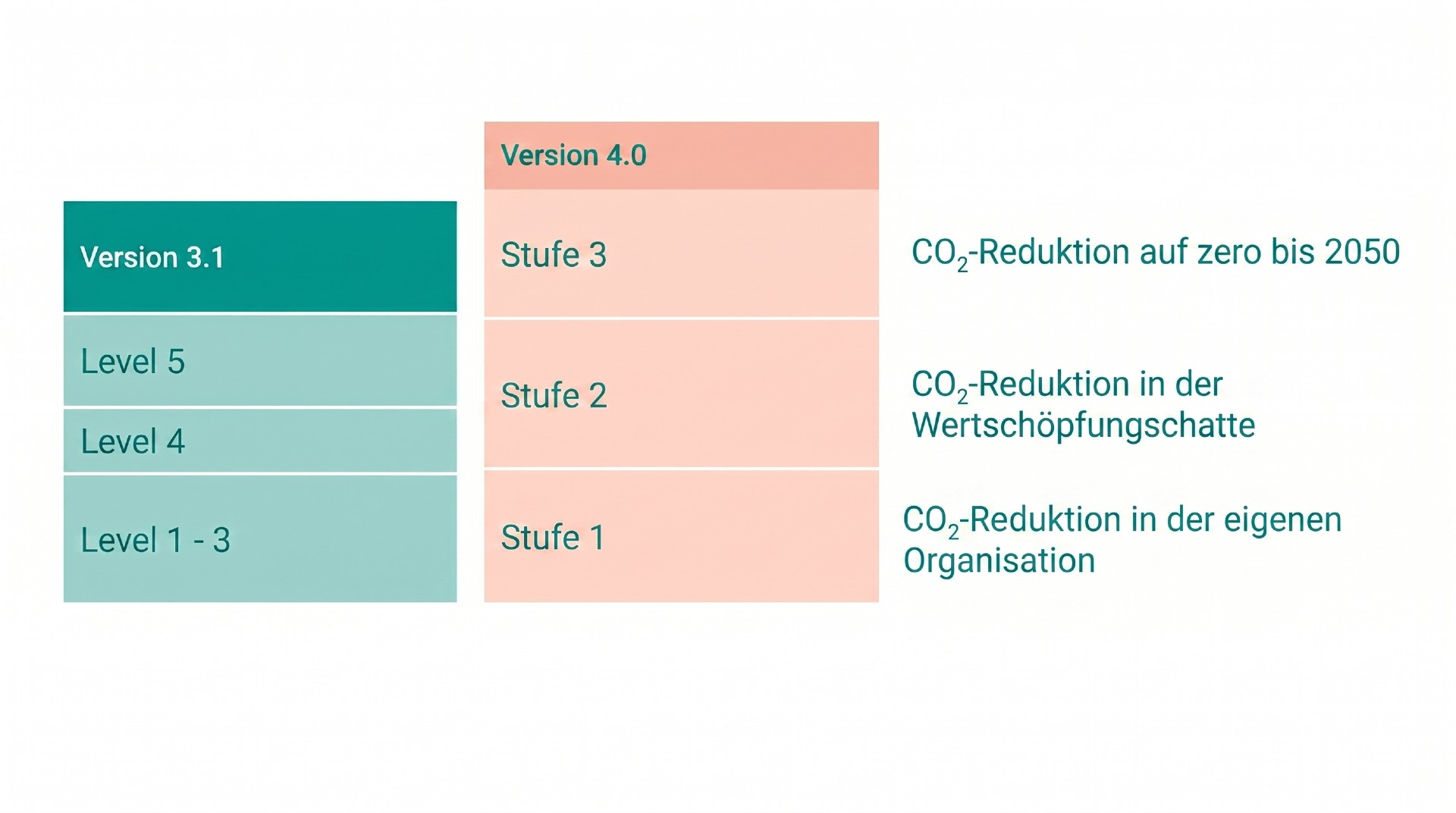
Ein Zertifikat der Stufe 1 für Handbuch 4.0 wird als Zertifikat des Niveaus 1, 2 und 3 von Handbuch 3.1 akzeptiert
Ein Zertifikat der Stufe 2 für Handbuch 4.0 wird als Zertifikat des Niveaus 4 und 5 von Handbuch 3.1 akzeptiert
Ein Zertifikat der Stufe 3 für Handbuch 4.0 wird als Zertifikat des Niveaus 4 und 5 von Handbuch 3.1 akzeptiert
SKAO empfiehlt, 4.0-Zertifikate als Nachweis für 3.1-Ausschreibungen zu akzeptieren.
Erfordert der Übergang zu Version 4.0 zusätzlichen Aufwand für meine Organisation?
Version 4.0 of the CO₂ Performance Ladder brings changes compared with the previous version, 3.1. The five certification levels have been replaced by three Steps, and organisations are asked to show even more ambition when it comes to reducing their own CO₂ emissions (scope 1 and 2), their emissions in the value chain (scope 3) and emissions outside the value chain. Organisations also need to pay more attention to energy saving, long-term ambitions and embedding CO₂ reduction more widely across the organisation.
For most organisations currently certified at Level 3 under Handbook 3.1, a comparable effort will qualify them for Step 1 of version 4.0. Step 2 of version 4.0 requires an effort comparable to Level 5 of version 3.1, but differs in content. Scope 3, for example, must be mapped more completely, and organisations are introduced to other influenceable emissions (OIE). The horizon for targets also shifts to the medium term. These targets only need to be set for the most significant activity or activities.
In general terms, the effort required to meet Step 1 and Step 2 of Handbook version 4.0 is equivalent to version 3.1 as follows:
What is the advantage of external verification?
The contracting authority does not have to assess compliance with all requirements itself. This assessment is carried out by an independent, accredited certification body. This ensures an objective assessment, reduces the administrative burden for the contracting authority, and provides independent assurance of performance.
Welche Auftraggeber nutzen die CO₂ Performance Ladder für die Vergabe?
Mehr als 8.000 Organisationen besitzen ein Zertifikat für die CO₂ Performance Ladder, und über 300 öffentliche Auftraggeber nutzen die Ladder in ihren Ausschreibungen. Dazu gehören nationale Behörden, Kommunen, Wasserverbände und Provinzen. Eine Übersicht dieser Auftraggeber finden Sie auf der Seite Vergabestellen.
Kann ich mit der CO₂ Performance Ladder sozial verantwortlich einkaufen?
Ja! Die CO₂ Performance Ladder ist Teil des niederländischen Leitfadens für sozial verantwortliche Beschaffung (SRI). Weitere Informationen finden Sie auf der Website von Pianoo.
Woher weiß ich, ob die ausgezeichnete Organisation Maßnahmen für mein Projekt ergreift?
Wird mit dem CO2-aware-Zertifikat die Einhaltung des BPKV-Kriteriums nachgewiesen, verfügt das zertifizierte Unternehmen über ein funktionierendes CO2-Managementsystem das jährlich auditiert wird. Bei diesem Audit werden nicht nur die Ziele und Maßnahmen auf Unternehmensebene betrachtet, sondern auch stichprobenartig die Projekte mit CO2 Performance Ladder Auszeichnungsvorteil, die ein Unternehmen durchführt, geprüft. Das Audit wird jährlich von einer unabhängigen Zertifizierungsstelle (ZS) durchgeführt.
Wird die Erfüllung des BPKV-Kriteriums projektspezifisch nachgewiesen, muss ein Unternehmen Reduktionsmaßnahmen am Projekt umsetzen und eine CB prüft, ob diese Maßnahmen tatsächlich umgesetzt werden und erstellt darüber eine Projektbescheinigung.
Was passiert, wenn ein Unternehmen die vereinbarte CO₂-Ambitionsstufe nicht erreicht?
Es kann vorkommen, dass der Auftragnehmer die Anforderungen des Zuschlagskriteriums der CO₂ Performance Ladder weder vollständig noch rechtzeitig durch eine Projekt-Erklärung oder ein Zertifikat erfüllen kann. In diesem Fall muss die Vergabestelle in den Vergabeunterlagen eine Sanktion vorsehen.
Empfohlen wird, eine Sanktion vorzusehen, die den gewährten Vergabevorteil übersteigt. Zur Bestimmung der Höhe der Sanktion wird die Differenz zwischen dem im Vergabeverfahren gewährten Qualitätswert – der vereinbarten CO₂-Ambitionsstufe – und dem tatsächlich erreichten Qualitätswert (CO₂-Ambitionsstufe) berechnet und mit einem Faktor multipliziert (z. B. 1,5). Ein Beispiel für eine Sanktion sowie eine Musterformulierung für eine Sanktionsklausel finden sich im Beschaffungsleitfaden 4.0.
Beispiel für eine Sanktion: Die CO₂-Ambitionsstufe 2 führte bei Angebotsabgabe zu einem Zuschlagsvorteil von 75.000 € (fiktiver Abschlag), wurde jedoch vom Auftragnehmer nicht erreicht. Der Auftragnehmer legt ein CO₂ Performance Ladder-Zertifikat auf Stufe 1 vor, dem ein Zuschlagsvorteil von 37.500 € entspricht. Die Höhe der Sanktion beträgt somit 1,5 × (75.000 € − 37.500 €) = 56.250 €.
Anyone starting certification usually focuses on one moment: the first audit. That makes sense, since it’s the step that counts for the tender you’re currently pursuing. What comes afterwards matters just as much, however: keeping your CO₂ Performance Ladder certificate. It’s a system with its own rhythm, one you…
By getting to grips with other influenceable emissions (OIE), you can impact emission reduction beyond your organisation and even your value chain as well. In this blog we explain why OIE are part of the new version of the CO₂ Performance Ladder, the categories of OIE, when you must…
Newsletter erhalten?
Möchten Sie alle zwei Monate Updates, Projektbeispiele und Neuigkeiten über die CO2 Performance Ladder erhalten? Abonnieren Sie unseren Newsletter!
„*“ zeigt erforderliche Felder an
Manage Consent
To provide the best experiences, we use technologies like cookies to store and/or access device information. Consenting to these technologies will allow us to process data such as browsing behavior or unique IDs on this site. Not consenting or withdrawing consent, may adversely affect certain features and functions.
Functional
Always active
The technical storage or access is strictly necessary for the legitimate purpose of enabling the use of a specific service explicitly requested by the subscriber or user, or for the sole purpose of carrying out the transmission of a communication over an electronic communications network.
Preferences
The technical storage or access is necessary for the legitimate purpose of storing preferences that are not requested by the subscriber or user.
Statistics
The technical storage or access that is used exclusively for statistical purposes.The technical storage or access that is used exclusively for anonymous statistical purposes. Without a subpoena, voluntary compliance on the part of your Internet Service Provider, or additional records from a third party, information stored or retrieved for this purpose alone cannot usually be used to identify you.
Marketing
The technical storage or access is required to create user profiles to send advertising, or to track the user on a website or across several websites for similar marketing purposes.