Organisations across Europe face growing pressure to demonstrate credible climate action – from regulators, clients and investors alike. CO₂ Performance Ladder 4.0 gives that ambition a clear structure and an internationally recognized way to demonstrate ambition, and results.
Version 4.0 builds on more than fifteen years of experience. The Ladder is now active across seven European countries and used by over 8,000 organisations. This article explains what version 4.0 is, what has changed, and what it means in practice.
What is the CO₂ Performance Ladder?
The CO₂ Performance Ladder is both a procurement instrument and a CO₂ management system that helps organisations structure and demonstrate their CO₂ reduction efforts. Certified organisations commit to concrete targets, measure their emissions, and are independently audited. The certificate is widely used in public procurement: contracting authorities award competitive advantages to certified organisations, creating a direct business case for climate action.
Research shows that organisations certified for the Ladder reduce CO₂ twice as fast as non-certified organisations and procuring with the Ladder is linked to local reductions in CO₂ emissions. And its use in public procurement is linked to improved technological innovation among companies.
Why version 4.0?
Version 4.0 was developed in response to market demand. Certificate holders, contracting authorities and certification bodies called for a more ambitious standard, better aligned with international frameworks. Specifically, they asked for:
- Stronger alignment with the Paris Agreement and long-term zero-emissions objectives.
- Better differentiation for frontrunners, while keeping an accessible entry point for newcomers.
- Alignment with international standards, including the EU’s Corporate Sustainability Reporting Directive (CSRD).
- Clearer focus on where organisations can achieve the greatest CO₂ impact.
- Improved readability and structure of the Handbook.
A new structure: three Steps
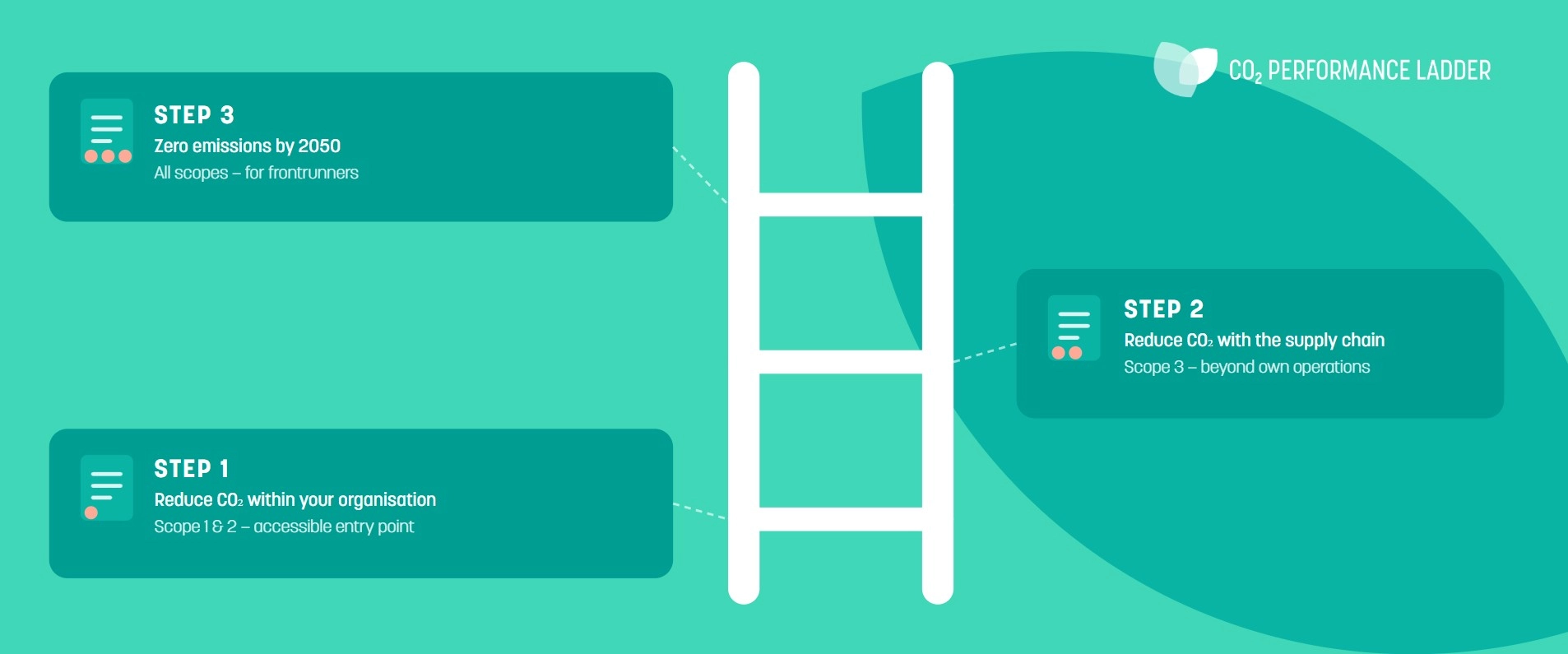
The CO₂ Performance Ladder 4.0 is structured around three Steps. This provides a clear progression model and makes it easy for organisations to identify where they stand and what the next stage requires.
Step 1 – Reducing CO₂ within your own organisation
Step 1 focuses on an organisation’s direct operations – scope 1 and scope 2 emissions. It is designed as an accessible entry point for organisations beginning to structure their climate approach. Key changes include:
- Non-CO₂ greenhouse gases (such as methane and nitrous oxide) are now explicitly included when relevant to the organisation.
- Greater emphasis on saving energy, not just switching to greener sources.
- Organisations must map CO₂ awareness across all layers of the organisation, not just at management level.
Step 2 – Reducing CO₂ with the supply chain
Step 2 extends the scope of action to include scope 3 – emissions in the value chain, both up and downstream. This is where many organisations have their largest CO₂ impact. Key changes include:
- Organisations focus on the emissions where they can make the most impact,
- A mandatory Climate Transition Plan, setting out short, medium and long-term steps towards zero emissions.Other influenceable emissions (OIEs) – such as emissions from bio-based materials or energy sharing with neighbouring organisations – must be qualitatively analysed.
Step 2 requires a significantly higher level of ambition and is designed for organisations ready to look beyond their own operations.
Step 3 – Zero emissions by 2050
Step 3 is designed for frontrunners. It requires a full commitment to eliminating emissions across all scopes – 1, 2 and 3 – by 2050 at the latest, supported by a Climate Transition Plan with concrete milestones and active supply chain engagement. It sets a standard that even organisations with strong existing ambitions will need to work hard to achieve.
Alignment with CSRD, SBTi and international standards
A key improvement in version 4.0 is its closer alignment with international frameworks. By meeting the requirements of CO₂ Performance Ladder 4.0, organisations cover a substantial part of ESRS E1 – the climate change component of the EU’s CSRD. The footprint produced under Ladder requirements can be used directly in a CSRD report, since both use the same scope classification and include all greenhouse gases.
Version 4.0 also aligns more closely with the Science Based Targets initiative (SBTi) and the Paris Agreement. For organisations already working with these frameworks, the Ladder provides a practical, certified implementation structure.
The Ladder in procurement
The CO₂ Performance Ladder is actively used as an award criterion in public tenders across Europe. Contracting authorities award competitive advantage to higher-certified tenderers, making certification a tangible business argument.
From ambition to zero emissions by 2050
CO₂ Performance Ladder 4.0 is designed for the decades ahead. By combining a clear step structure, a long-term planning horizon and alignment with international frameworks, it gives organisations a practical and credible path from climate ambition to measurable action – whether they are taking their first steps or working towards net zero across their entire supply chain.
Want to know more? Explore the full Handbook.