
- Blog
Calculating a carbon footprint for the CO₂ Performance Ladder 4.0
Calculating a carbon footprint for the CO₂ Performance Ladder 4.0 is simpler than it seems: what each Step requires, how to start and which mistakes to avoid.


CO2 Performance Ladder 4.0 aims to align as closely as possible with international standards and legislation, such as the Corporate Sustainability Reporting Directive (CSRD) and the Science Based Targets initiative (SBTi). But what exactly is their relationship between them? Where do they differ or converge? In this blog, we discuss the challenges and opportunities for organisations when integrating the Ladder, CSRD and SBTi.
Anyone dealing with emissions reduction within an organisation is often snowed under in abbreviations, guidelines, norms and standards. It is often a huge task to find out exactly what everything means and how they are interconnected. For example, when it comes to the relationship between the CO₂ Performance Ladder, the CSRD and the SBTi.
The CO₂ Performance Ladder is an instrument that helps companies and governments to reduce CO₂ emissions within their own organisation and in the supply chain. By using a management system to gain insight into CO₂ emissions, organisations can work on reducing their emissions on a systematic and structural basis. In addition, the CO₂ Performance Ladder can be used as a procurement instrument.
The Corporate Sustainability Reporting Directive is a European directive that requires large organisations to report on the three aspects of sustainability: environmental, social and governance. In the report, a company records how these themes affect its own organisation and how the organisation effects these three themes. The requirements a CSRD report must meet are set out in the European Sustainability Reporting Standards (ESRS).
The Science Based Targets initiative is a collaboration between the World Resources Institute, the United Nations Global Compact and the World Wildlife Fund, among others. The initiative helps companies with tools, standards and guidelines to set climate targets towards 2050 that are based on the latest scientific findings, known as Science Based Targets.
The CO2 Performance Ladder, CSRD and SBTi all have both similarities and differences:
The CO2 Performance Ladder, CSRD and the SBTi are all in line with the Greenhouse Gas (GHG) Protocol standards and the goals of the Paris climate agreement. They also all focus on emissions across scopes 1, 2 and 3 and have as a requirement that a carbon footprint and climate targets are established and transparently communicated. All three also involve validation, in the case of the Ladder and CSRD by a third party.
At the same time, there are a number of differences between the Ladder, CSRD and the SBTi. The main ones are:
“The CSRD and the SBTi have a certain threshold. The CO2 Performance Ladder takes you by the hand and helps you set things up and anchor them internally.”
Jeroen Scheepmaker, BLU3Point.
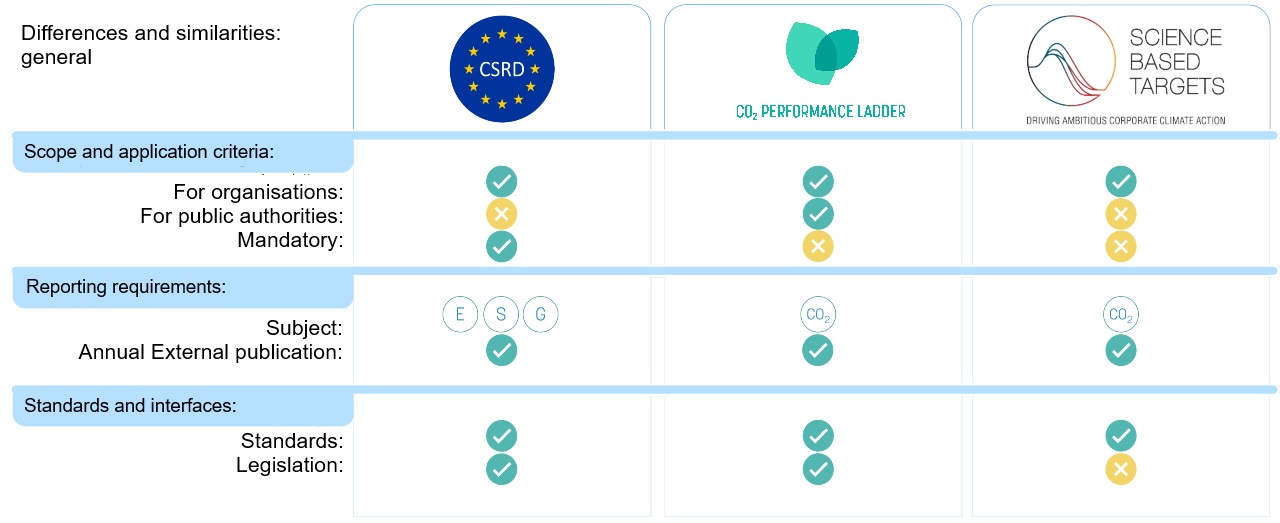
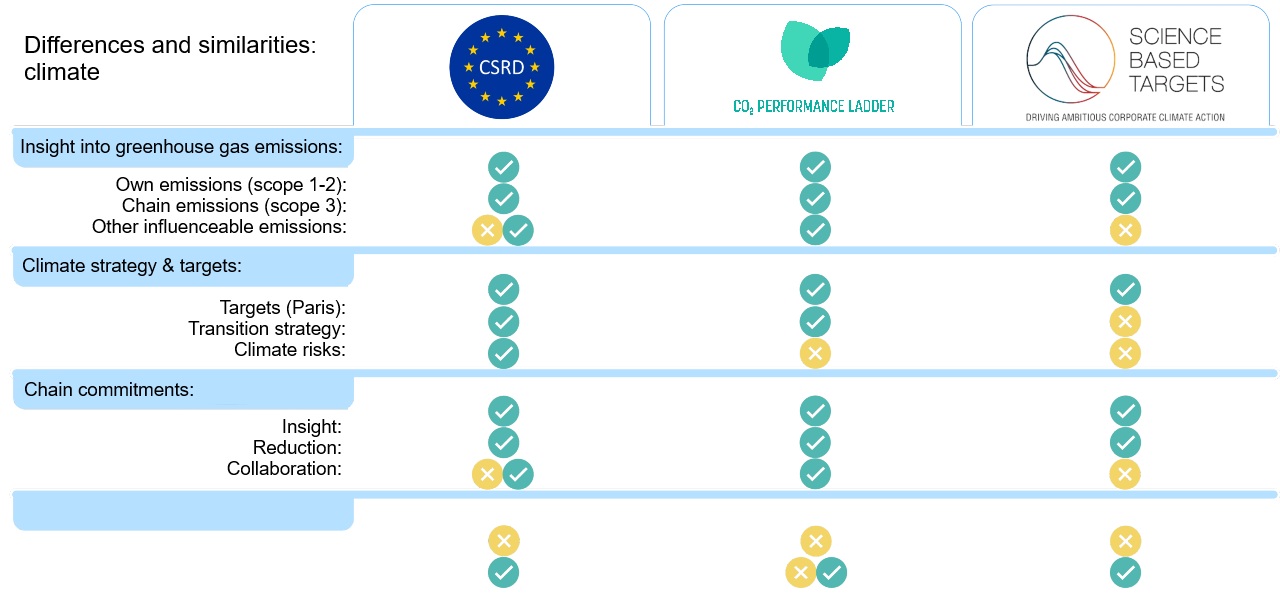
The CO₂ Performance Ladder 4.0, CSRD and SBTi can be cleverly linked to each other. For example, the Ladder provides substantiation for CSRD reporting. The Ladder provides guidance for drawing up a climate plan and collecting data in a structured way, as well as a CO2 management system to ensure that you comply with the measures and ambitions and communicate them transparently. By using the SBTi method, you know that your reduction objectives have a scientific basis.
Read more about the relationship between the CO2 Performance Ladder and the CSRD and about the SBTi and Ladder as complementary tools.
“You can use the CO2 management system of the CO2 Performance Ladder within the CSRD. That’s a nice cooperation you can find if you are obliged to comply with the CSRD.”
Marieke Reijnen (Duurzame Cijfers)
In the Dutch video below (with English subtitles), Jeroen Scheepmaker, Marieke Reijnen and Marjan Kloos elaborate on the relationship between the CO₂ Performance Ladder 4.0, CSRD and SBTi. They also answer questions from organisations that attended the session. The main questions asked are addressed in the FAQ below. Should you still have questions after watching the webinar, please contact us.
Absolutely. Many of the topics and requirements will overlap (such as determining scope 1, 2, and 3 emissions), or at least be closely related (such as developing a communication plan or collaborating with partners). Where there is overlap, version 4.0 of the CO₂ Performance Ladder is designed to allow for one combined report to meet the requirements of different frameworks. On other topics, the Ladder offers an excellent complement, also helping to enhance the impact of CSRD and SBTi.
Although there is some overlap, the approaches are different. First, the number of themes in the double materiality analysis (DMA) is much broader than climate change: it also covers, for instance, pollution, human rights, good governance, and water use. If we focus on climate change, one half of the DMA concerns the financial impact of climate change/policy on the organisation. This falls outside the scope of the Ladder. The other half concerns the organisation’s impact on climate change. This is also the focus of the impact and influence analysis. One key difference is that the Ladder looks beyond scope 1, 2, and 3 by also including biogenic emissions, CO₂ removals, and avoided emissions. Another difference is that the Ladder provides a more structured approach, using a table that incorporates quantitative data to establish a ranking.
All organisations that draw electricity from the grid can only report zero emissions from electricity if they purchase Guarantees of Origin (GOs) from their own country. It does not matter whether they have supplied electricity to the grid at another time (e.g., from solar panels). Read more about the Ladder and green electricity.
The footprint is always reviewed during the external audit. For more extensive emissions inventories, this may involve sampling, whereby the focus of the audit can vary from year to year.
An organisation starting now can choose either system. However, there are some considerations, such as the fact that audits for version 4.0 can only take place from 14 July 2025 onwards, and the question of when contracting authorities are likely to switch. For a more detailed explanation, see this article.
The Ladder is stricter than the CSRD in this regard: an organisation is expected to achieve its short-term targets or implement its planned short-term measures at all levels. In line with the management system approach, there is of course room for continuous improvement if achieving these targets or measures turns out to be impossible. This is referred to as comply-or-explain. Since ‘comply’ is the starting point, the organisation must provide a well-substantiated explanation if ‘explain’ proves necessary.
SMEs with fewer than 250 FTEs (among other criteria) were already exempt from CSRD reporting requirements. Under the new proposal, it is also less likely that they will be included in the value chain of a CSRD-obligated company. As a result, they are expected to be asked to provide sustainability reports less frequently.
The main difference is that, under the climate transition plan (CTP) of the Ladder, the organisation must look beyond its own chain(s) and therefore beyond scope 1, 2, and 3. This is referred to as other influenceable emissions (OIE). Another difference is that the Ladder does not address the financial impacts of climate change or climate policy on the organisation (which CSRD does), but focuses solely on the organisation’s impact on the climate. A further difference is that CSRD reporting is verified by an accountant, while the CO₂ Performance Ladder is audited by a certification body. Finally, the Ladder only looks at the organisation’s CO₂ reduction potential and does not allow for offsetting with carbon credits, as the CSRD may. Read more about the relationship between the Ladder and the CSRD.
Read all about the transitional arrangements in this article.
If all competitors in a tender process are certified at the same level, then the CO₂ Performance Ladder certificate will not provide a competitive advantage for that specific tender. However, in practice, this is still far from the case in many (sub)sectors: many organisations are not yet certified, or there is significant variation in the levels achieved. This variation is only expected to increase with the introduction of version 4.0 and its higher level of ambition.
Zero emissions literally means: no emissions of fossil greenhouse gases. This is the ultimate goal of the climate transition plan at level 3. Version 4.0, like earlier manuals, does not allow for CO₂ offsetting. CO₂ offsetting refers to the idea that a portion of an organisation’s scope 1, 2 or 3 emissions could be cancelled out using carbon credits purchased on the voluntary carbon market. If offsetting is used, this would be referred to as ‘net zero’ or net-zero emissions.
The Omnibus package is a proposal by the European Commission to combine, simplify, and postpone several sustainability regulations, including the CSRD. Although the package has not yet been approved by the EU Member States and the European Parliament, it currently means that fewer organisations are obliged to comply with the CSRD in the short term. Read this article for more information on the topic.
From 14 July 2025 onwards. Read all about the transitional arrangements here.
If the package is adopted, companies with at least 1,000 FTEs and either a turnover of at least €50 million or a balance sheet total of at least €25 million will remain subject to CSRD. Read more about the Omnibus proposal here.
Unlike large companies, municipalities are not required to comply with the CSRD. For them, both CSRD and the Ladder are voluntary choices. Municipalities that opt for the Ladder are unlikely to gain much added value on the topic of climate from a CSRD report. In many cases, the Ladder already goes further than the CSRD in this area. On all other topics—such as human rights and good governance—the CSRD can, of course, be useful.
Calculating a carbon footprint for the CO₂ Performance Ladder 4.0 is simpler than it seems: what each Step requires, how to start and which mistakes to avoid.

Thousands of organisations now publish a carbon footprint and set a climate target. However, research from the MIT Sloan School of Management points to a gap between setting a target and actually reducing emissions. Setting a target says little on its own about whether emissions actually go down afterwards.
Receive newsletter?
Would you like to receive updates, project cases and news about the CO2 Performance Ladder every other month? Subscribe to our newsletter!
"*" indicates required fields