The Hague first large city to receive CO₂ Performance Ladder 4.0 certification
As the first of the major Dutch municipalities, The Hague has been certified on version 4.0 of the CO₂ Performance Ladder, at Step 1. Achieving the certificate was no straightforward task. There were questions about whether the CO₂ footprint was correct, and identifying key persons also proved quite an undertaking. “But it was precisely the things that didn’t go entirely smoothly that kept us sharp and led to some interesting conversations.” The city is already progressing towards Step 2.
Gaining insight into your own processes and emissions is the foundation for doing something about a cleaner world. According to Erik Versteegh, Sustainability Adviser for the Municipal Organisation, the CO₂ Performance Ladder is an excellent tool for gaining that insight. “Using data on our energy consumption and associated CO₂ emissions, we can set targets and take action to reduce our footprint. There are other tools you can use, but the fact that the Ladder is based on the GHG Protocol, includes an annual independent audit, and has been widely embraced in the Netherlands makes it a reliable and valuable instrument. We also think it’s important to lead by example. After all, we use the Ladder as an award criterion in our tenders. It only makes sense that we actively work on CO₂ reduction ourselves and have in-house knowledge of what we ask of others.”
“We also think it’s important to lead by example. After all, we use the Ladder as an award criterion in our tenders. It only makes sense that we actively work on CO₂ reduction ourselves and have in-house knowledge of what we ask of others.”
Reducing gas consumption
The municipality’s goal is to achieve a 30% CO₂ reduction by 2027 compared to 2023. Approximately half of its CO₂ emissions come from burning gas to heat municipal buildings. The municipality has made some significant strides in this area in recent years, says Versteegh. “Since last year, one of the municipal swimming pools – De Blinkerd – has been heated using sewer heat recovery, which extracts residual heat from the sewage system. This saves 170,000 cubic metres of gas per year. At the same time, there is still a great deal of room for improvement. Some of our buildings, including the city hall, are connected to the district heating network. Two thirds of those central heating units are powered by gas boiler systems. We don’t have direct influence over those, but we are looking at ways to reduce heat and gas consumption – for example by insulating buildings better or exploring alternative heating sources.”
Less energy and cleaner electricity
Alongside measures to reduce gas consumption, the municipality is focusing on cutting electricity use and making it greener. Versteegh: “We are busy replacing lighting in public spaces and our buildings with LEDs. This is considerably more energy-efficient than the old lighting. We are also transitioning our vehicle fleet from diesel and petrol cars to electric vehicles. The electricity used in the charging points on our premises is fully renewable.” These sustainability measures delivered a CO₂ saving of 6,370 tonnes between 2023 and 2024 – a reduction of 12.5%, which actually exceeded the municipality’s target of 10% per year. This helped the municipality meet the requirements of level 3 of the ladder (version 3.1).
Getting to work with version 4.0
When the latest version of the Ladder – version 4.0 – was launched at the beginning of 2025, The Hague decided to adopt it straight away, says Versteegh. “We were enthusiastic about the update. The new version focuses even more than the previous one on the areas where you can make an impact. The better you can identify the hotspots of energy consumption and CO₂ emissions, the more targeted your actions can be. Given that there are some new elements in the new handbook – such as key persons and non-CO₂ greenhouse gases – we asked our external sustainability advisers to carry out an internal audit first, as a kind of rehearsal for the real audit. This way we’d know what to expect and could still correct any issues in time, such as broken links on the website.”
Aligning the internal and external audit
Since the consultants needed some time to work everything out properly, the internal audit took place just before the Ladder audit, says Versteegh. “That wasn’t ideal, as we had very little time to address any shortcomings. During the actual Ladder audit, it also became clear that a number of things had not been adequately covered in the internal audit. One of these was that our key persons had not been interviewed. As a result, they weren’t really clear on what they would be asked and assessed on during the Ladder audit. Fortunately, we had identified all key persons and briefed them on what their role entailed. But it would have been better if they had been interviewed beforehand. That’s a good lesson we’ve learnt: make sure the internal audit closely mirrors the real audit.”
Green or grey electricity at charging points
Another contentious issue during the audit was a potential discrepancy in the CO₂ footprint. According to Versteegh, this related to the question of whether electricity used at charging points not managed by the municipality was renewable or from the grid. “Our own charging points all use renewable electricity, but public charging points generally tend to use standard grid electricity. Initially, we assumed that the majority of our fleet was charged at our own points, but it turned out things were somewhat different. I still needed to find out what proportion was charged at public points and what type of electricity those points used. For GDPR reasons, charging point operators were unwilling to share data about when a particular vehicle had charged at a given location. Fortunately, I discovered that a few years ago we had run a procurement process for the installation of charging points using renewable electricity. Collecting the certificates confirmed that all public charging points in our municipality use renewable electricity.”
Certification at Step1 of Ladder 4.0
The finding was a great relief for Versteegh, as it meant nothing stood in the way of certification at Step 1 of CO₂ Performance Ladder 4.0. “We had assumed that moving from level 3 (version 3.1) to Step 1 (version 4.0), apart from the new elements, wouldn’t require a great deal of work – but in the end it did take quite some effort. Perhaps we had underestimated it. But it’s no bad thing to be kept on your toes. It also depends on the auditor to some extent – a given auditor may place slightly different emphases than another. In the end, you do get time to answer questions, look things up, and gather additional documentation. But everything does need to be in order, of course. Fortunately, that was the case. We’re very proud of our certification according to version 4.0, and of course of our contribution to reducing environmental harm.”
Discussion about the role of key persons
Working with the new elements of Ladder 4.0 also sparked some interesting internal discussions, according to Versteegh – for example around the role of key persons. “These include our energy coordinators. I felt they should take on a more active role as key persons in contributing to CO₂ reduction. But this didn’t quite align with the function they were actually performing. We had conversations about that, which were very useful. We found that not everyone was entirely clear on the mandate they had to speak on energy savings, and that the term ‘key person’ can sometimes feel rather weighty. Ultimately, this led to the key persons feeling more involved and accountable for CO₂ reduction within the organisation.”
“We need to get data from the entire supply chain. This involves partners delivering works, such as clients for construction projects, but also the procurement of goods and services, such as IT.”
Moving towards Step 2
With a Ladder certificate for Step1 in hand, the Municipality of The Hague wants to push straight ahead towards Step 2. That will require considerable additional effort, says Versteegh. “We need to get data from the entire supply chain. This involves partners delivering works, such as clients for construction projects, but also the procurement of goods and services, such as IT. How many laptops do we have, where do they come from, what components do they contain, how much CO₂ was emitted in their production? We need to find all of that out. It’s an interesting but complex task. Firstly, because not all companies have data on the CO₂ footprint of their products, or are willing to share it – so we really need to be proactive about that. And secondly, people within our own organisation aren’t occupied with gathering emissions data on a daily basis. It will take some time to get all of this properly organised.”
When ‘green’ isn’t the whole story
Looking beyond your own organisation’s emissions also means you may end up making different choices, Versteegh continues. “From a scope 1 perspective, it makes sense to generate your own energy with solar panels or install a heat pump. But products like these also have a negative side, such as CO₂ emissions during production and harmful gases that can be released if they break down. They also require maintenance and sometimes have a limited lifespan. You don’t want everything to look great for your own organisation while you’re causing pollution elsewhere in the supply chain. We need to factor that into our energy targets too. We won’t blindly push for solely self-generated energy – choices need to be carefully weighed up. I’m very curious to see what insights that will bring. But it’s certainly a good thing that we’re becoming ever more conscious about tackling this.”
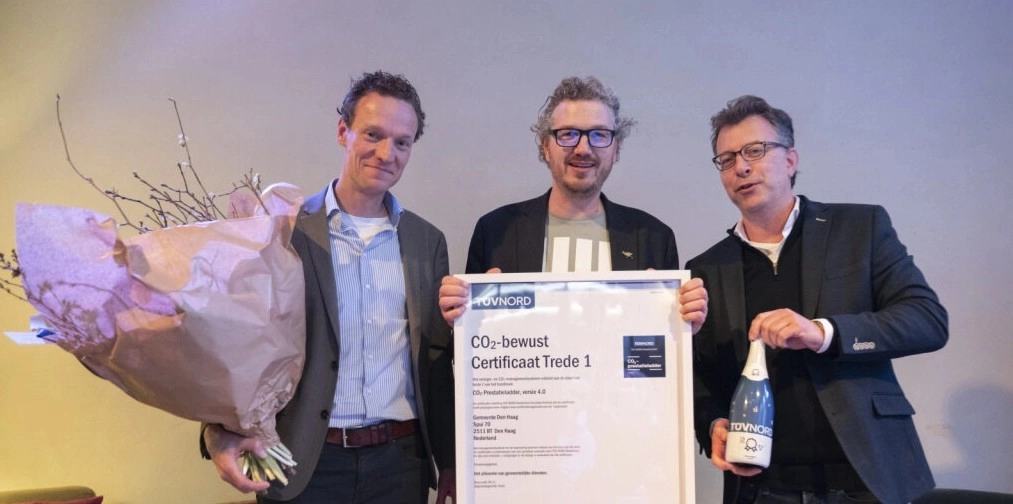
Photo taken by Henriëtte Guest. From left to right: Tijmen de Groot (SKAO), Arjen Kapteijns (Councillor for The Hague) and Gerben van Horssen (TÜV Nord).
This article focuses on the Dutch implementation of the revised Energy Efficiency Directive (EED). The EED is a European directive that each EU Member State translates into national legislation and regulations. As a result, obligations, thresholds, and enforcement may differ from one country to another. In the Netherlands,…
Barneveld has become one of the first municipalities certified at Step 1 of the CO2 Performance Ladder version 4.0. The local authority in Gelderland is strongly committed to reducing and greening its energy consumption, including through the procurement of locally generated energy. By establishing and supporting sustainable energy initiatives, Barneveld aims not only to reduce CO2 emissions, but also to stimulate the local…
Receber o boletim informativo?
Gostaria de receber atualizações, casos de projetos e notícias sobre a CO₂ Performance Ladder a cada dois meses? Inscreva-se na nossa newsletter!
"*" indica campos obrigatórios
Manage Consent
To provide the best experiences, we use technologies like cookies to store and/or access device information. Consenting to these technologies will allow us to process data such as browsing behavior or unique IDs on this site. Not consenting or withdrawing consent, may adversely affect certain features and functions.
Functional
Always active
The technical storage or access is strictly necessary for the legitimate purpose of enabling the use of a specific service explicitly requested by the subscriber or user, or for the sole purpose of carrying out the transmission of a communication over an electronic communications network.
Preferences
The technical storage or access is necessary for the legitimate purpose of storing preferences that are not requested by the subscriber or user.
Statistics
The technical storage or access that is used exclusively for statistical purposes.The technical storage or access that is used exclusively for anonymous statistical purposes. Without a subpoena, voluntary compliance on the part of your Internet Service Provider, or additional records from a third party, information stored or retrieved for this purpose alone cannot usually be used to identify you.
Marketing
The technical storage or access is required to create user profiles to send advertising, or to track the user on a website or across several websites for similar marketing purposes.