From purification to reduction: how NORIT is tackling its own CO₂ emissions
Your tapwater has been purified with it. So has the sugar in your tea. The petrol fumes in your car are captured by it. Activated carbon is one of the most widely used purification materials in the world, and NORIT has been making it for over a hundred years. For a company that contributes to cleaner water and cleaner air, its own CO₂ emissions inevitably come under scrutiny. The company is now certified on Step 1 of the CO₂ Performance Ladder.
A football pitch in a few grams
Rob de Jonge has worked with activated carbon for 31 years. When he talks about it, his fascination is still unmistakable: “A single gram of activated carbon easily has a thousand square metres of internal surface area,” he explains. “You can barely see the granules if you scatter them on the centre spot of a football pitch. Yet that entire pitch is folded up inside those few grams.”
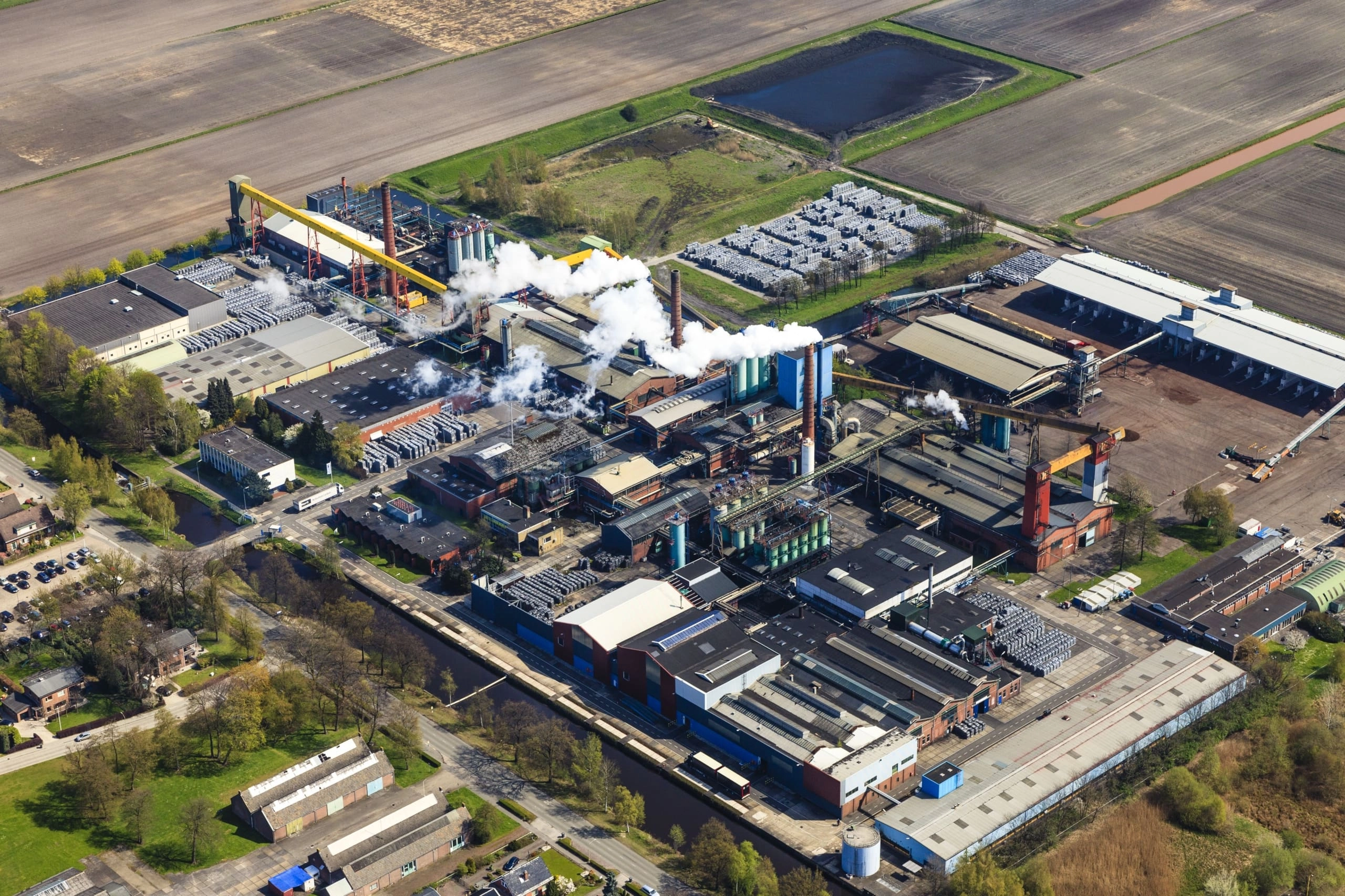
That enormous surface area is created through a thermal activation process: carbon-rich raw materials such as wood, coconut shells, peat and coal are treated at temperatures of around 900 degrees. This produces a fine network of pores for unwanted substances to adhere to – pesticides, odorous compounds, colourants and pharmaceutical residues.
The principle is simple. The applications are endless. NORIT has nine production sites worldwide and supplies drinking water companies, pharmaceutical manufacturers, gold mines and the food industry. “You use our products indirectly every day,” says Rob. “Most people just don’t realise it.”
What is activated carbon?
Activated carbon is a form of carbon with an extremely porous structure. By heating raw materials such as wood, coconut shells, peat or coal under controlled conditions, a material with millions of microscopic pores is created.
As a result, activated carbon has an enormous internal surface area – up to 1,000 square metres per gram. Substances from water or air can attach to that surface; a process known as adsorption.
Thanks to this property, activated carbon is used worldwide to remove unwanted substances from liquids and gases. Applications include:
drinking water purification
removal of pharmaceutical residues and PFAS from water
decolouring of sugar and food ingredients
purification of air and industrial gases
gold extraction in mining
A notable characteristic of activated carbon is that the material can often be reactivated and reused. Contaminants are removed at high temperature, after which the carbon is ready for use again.
Yet there is also a downside to this story. The production process for activated carbon generates significant CO₂ emissions. Both the activation and the reactivation of spent carbon require high temperatures. Furnaces must be brought up to temperature, moisture must be evaporated and gases must be burnt off.
Tharcis Zaaruolo, technical sales engineer and, alongside Rob, responsible for sustainability at NORIT Netherlands, puts it plainly:
“The largest share of our CO₂ emissions comes from two sources: the activation process itself, in which a great deal of carbon material is burned away to form the pores, and the combustion of gas during the reactivation of spent activated carbon.”
– Tharcis Zaaruolo
How a Belgian tender prompted the first step
The first step towards the CO₂ Performance Ladder did not stem from a strategic policy document, but from a Belgian tender. Certification at Step 1 yielded a notional price advantage. “We had to ask ourselves: are we going to do this?” says Rob. “Because it’s not something you can arrange quickly. You commit to targets, to transparency, to external audits.”
The decision was made. Not only because of the competitive advantage, but also because it aligned with something that was already stirring within the company. NORIT already held ISO certifications and reported emissions to government authorities. But an overarching system to structurally embed CO₂ reduction was missing. The CO₂ Performance Ladder provided that.
From ad hoc initiatives to a structured CO₂ policy
What makes the difference, says Tharcis, is the systematic approach. “You have to map your emissions, set reduction targets, measure progress and communicate with employees and stakeholders. It becomes part of your management cycle, not a standalone project running alongside normal business operations.” During the certification process, that systematic approach was translated into a practical working method.
During the path to certification, NORIT made use of the digital portal of the CO₂ Performance Ladder. Rather than an extensive PDF handbook, the platform provides an interactive structure in which all requirements, explanations and documents come together.
For Tharcis and Rob, this worked primarily as a practical guide through the process. “It set out exactly what you needed to submit,” says Tharcis. “Which documents were required and how far along in the process you were.”
The CO₂ approach has since been integrated into internal audits and management reviews. Rob: “It ensures you build in regular moments to look at it. That sounds simple, but it’s precisely that structure that makes the difference between intention and execution.”
For an organisation that has been part of various international ownership structures, that systematic approach also provides stability. Sustainability becomes less dependent on individual people and more embedded in processes.
From analysis to action
But insight alone does not reduce emissions. That is why NORIT drew up a concrete list of measures for its Dutch operations – projects that are genuinely intended to cut energy consumption and CO₂ emissions.
The greatest reductions lie in the production processes, where activation and reactivation furnaces account for a large share of emissions. These installationsare being adapted and optimised. A new afterburner, for example, makes use of residual heat from the process, reducing the need for natural gas. At the same time, the company is working on a fundamental shift in raw materials: fossil-based inputs are being replaced step by step with biogenic alternatives. This shifts a portion of emissions from fossil to biogenic.
Measures are also being taken elsewhere on the production site. More energy-efficient compressors and boiler installations, along with improved insulation, contribute to lower energy consumption. In addition, the company is looking at logistics and mobility – for instance by reducing and partly electrifying the vehicle fleet.
In this way, the CO₂ Performance Ladder becomes more than an administrative system: it becomes a list of concrete interventions in the production process itself. “In some cases we achieve five to ten per cent savings on natural gas,” says Rob. “That’s substantial.” The economic logic helps too. Lower energy consumption means lower costs. “Green measures are often simply efficiency measures,” says Tharcis. “That makes it easier to build internal support.”
Looking beyond the factory gate
Step 1 is not the end point for NORIT. The company wants insight into the full value chain: from raw material to finished product. “We can already calculate CO₂ footprints per product,” says Tharcis, “but we want to refine that further. That means collecting data from suppliers, factoring in transport and analysing raw material routes.”
The principle they apply here is one they also recognise from the CO₂ Performance Ladder itself: focus on where the greatest impact lies. Not everything at once, but targeted and measurable.
“You cannot claim to contribute to cleaner water and cleaner air whilst not looking critically at your own emissions. That would not be credible.”
– Rob de Jonge
No longer invisible work
NORIT is a company with over a hundred years of history. That long-term outlook also shapes its approach to sustainability. “You cannot claim to contribute to cleaner water and cleaner air whilst not looking critically at your own emissions,” says Rob. “That would not be credible.”
“The CO₂ Performance Ladder drives us to keep improving,” says Tharcis. “And that actually fits very well with who we already are.”
A company that has spent a century focused on purification has now also placed its own emissions under the microscope.
Using tools including the CO₂ Performance Ladder, DEME is working to reduce energy consumption and CO₂ emissions. It has now become the first major marine engineering company to achieve Step 3 certification under CO₂ Performance Ladder 4.0. With cleaner vessels, more efficient operations and greener energy carriers, the…
Arcadis Netherlands is the first engineering and consultancy firm to be certified at Step 3 of CO₂ Performance Ladder 4.0. Below, Sophie Hanekamp and Benjamin van Olffen explain how, at Arcadis, they drew up a Climate Transition Plan (CTP) in eight steps and share some useful tips along…
Receber o boletim informativo?
Gostaria de receber atualizações, casos de projetos e notícias sobre a CO₂ Performance Ladder a cada dois meses? Inscreva-se na nossa newsletter!
"*" indica campos obrigatórios
Manage Consent
To provide the best experiences, we use technologies like cookies to store and/or access device information. Consenting to these technologies will allow us to process data such as browsing behavior or unique IDs on this site. Not consenting or withdrawing consent, may adversely affect certain features and functions.
Functional
Always active
The technical storage or access is strictly necessary for the legitimate purpose of enabling the use of a specific service explicitly requested by the subscriber or user, or for the sole purpose of carrying out the transmission of a communication over an electronic communications network.
Preferences
The technical storage or access is necessary for the legitimate purpose of storing preferences that are not requested by the subscriber or user.
Statistics
The technical storage or access that is used exclusively for statistical purposes.The technical storage or access that is used exclusively for anonymous statistical purposes. Without a subpoena, voluntary compliance on the part of your Internet Service Provider, or additional records from a third party, information stored or retrieved for this purpose alone cannot usually be used to identify you.
Marketing
The technical storage or access is required to create user profiles to send advertising, or to track the user on a website or across several websites for similar marketing purposes.