
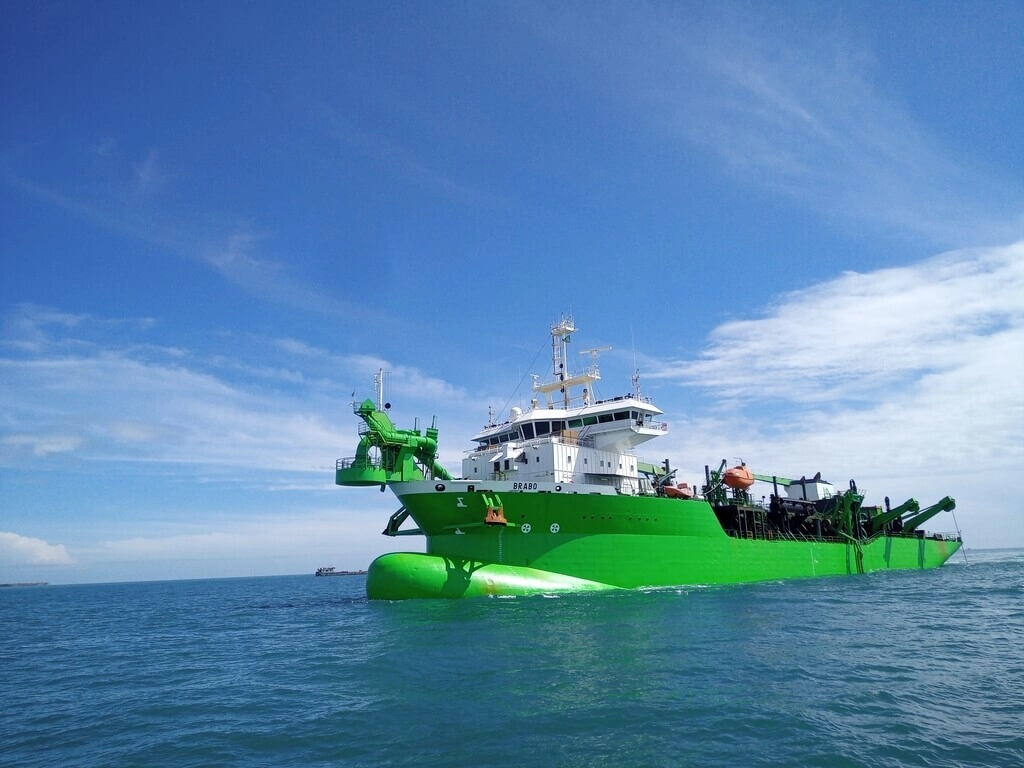
Using tools including the CO2 Performance Ladder, DEME is working to reduce energy consumption and CO2 emissions. It has now become the first major marine engineering company to achieve Step 3 certification under CO2 Performance Ladder 4.0. With cleaner vessels, more efficient operations and greener energy carriers, the company is working towards net-zero emissions by 2050. However, the speed and feasibility of achieving this target also depend on other parties, such as suppliers and clients. “The new version of the Ladder provides even more encouragement to engage in dialogue about sustainability.”
Dredging, constructing ports, sea locks and quay walls, and building and installing offshore wind turbines: the vast majority of DEME’s activities take place on or near the water. It is therefore unsurprising that the Belgian company’s main environmental impact comes from its vessels. According to Nick Deboever, QHSE Team Coordinator at DEME, these account for around 85 to 90 per cent of total energy consumption. “This is mainly related to carrying out activities, with dredging being the biggest energy consumer. Sand suction requires an enormous amount of energy. Traditionally, this has been powered by heavy diesel, which is where the largest emissions come from. Sailing from A to B also requires fuel, but that share is relatively small compared with carrying out the actual work.”
Working to reduce energy consumption and emissions
To minimise its environmental impact, DEME is constantly looking for ways to become more sustainable. Its strategy consists of three aspects, says Jeroen Gijzen, QHSE Manager at DEME Environmental Netherlands. “One is the operational side. By planning activities better and carrying them out more efficiently, we can save a lot of energy. The purchase of new installation vessels with greater fuel efficiency also falls under this heading. Another aspect is technological innovation, such as battery systems or hybrid systems on board vessels. The third aspect is the use of climate-neutral energy carriers. This is also the most challenging shift we need to make. Fuels and fuel engines for vessels are becoming cleaner and more efficient, but ultimately we want to move towards an energy carrier with no associated emissions. We are not there yet.”
Use of the CO2 Performance Ladder
Since the baseline year, 2008, making its fleet more sustainable has enabled DEME to achieve around a 30 per cent reduction in emissions per unit of work. According to its targets, this should reach 40 per cent by 2030. One of the tools the company uses is the CO2 Performance Ladder, Deboever explains. “We started working with it around 2010 because one of our clients, ProRail, required it in tenders. Particularly in the early years, we were awarded several projects partly thanks to our Ladder certification. But as more and more companies in the construction and infrastructure sectors became certified, often at Level 5, it became increasingly difficult to stand out. The Ladder has other benefits, though. It is a good management system that is aligned with the GHG Protocol and complements the ISO management systems we use at group level, such as 14001 (environmental management) and 50001 (energy management). It also provides a good basis for complying with the CSRD.”
More than just emissions from shipping
To ensure that the focus on energy savings and emissions reductions does not rest solely on shipping, DEME has identified four other significant energy consumers: earthmoving equipment, buildings, employee transport and procurement. By including these aspects in its footprint, DEME covers emissions across all scopes, says Deboever. “The Ladder requires insight into the entire organisation and value chain. That is how we identified the five significant energy consumers. Among other things, we are working to electrify cranes and machinery and make our vehicle fleet more sustainable. Through the latter, we have reduced emissions over the past 10 years from 112 to 36 grams of CO2 per kilometre driven. We are also working on the construction of a climate-neutral head office in Antwerp. The building will be equipped with the latest energy and climate technologies.”
Obstacles and limitations to becoming more sustainable
Despite these steps, the organisation also encounters limitations and obstacles when it comes to sustainability, Deboever acknowledges. “We do not own all of our buildings. We are therefore partly dependent on landlords, and sustainability is not always their highest priority. We also sometimes have to make trade-offs when it comes to procurement. For financial reasons or because of regional availability, the steel and concrete we use are not always the most environmentally friendly options.” Fuel availability is also a challenge, Gijzen adds. “In recent years, DEME has invested in a number of LNG vessels. However, the availability of LNG is limited: globally, it can only be bunkered in a limited number of locations. As a result, we sometimes have to fall back on conventional fuels. That is why, with our newest vessels, we are focusing as much as possible on flexibility, so that in the long term they can also run on net-zero-emission fuels, such as green methanol.”
Dependent on local energy infrastructure
The fact that activities never take place at a fixed location does not make things any easier, says Deboever. “We are not a biscuit factory that stays in the same place for decades. Every project we carry out takes place somewhere different, with a duration ranging from a few months to several years. We can engage in dialogue with regional stakeholders about investing in sustainable energy infrastructure, but by the time that infrastructure is in place, several years may have passed and we will have moved on.” Closer to home, things are often somewhat easier, says Gijzen. “In the coming years, we will be working at Schiphol on the remediation of contaminated soil. We will do that entirely using electric equipment. Thanks to the existing power supply at Schiphol, this is possible. There is also a huge solar farm next to the airport, so the electricity is completely green.”
Certificate only for Benelux entities
DEME consists of 178 entities spread across the world. Of these, 21 fall under the Ladder certificate. Deboever: “These are entities in the Benelux. The certificate is issued in the name of DEME NV, DEME’s operational entity. Having the entire group certified worldwide was not feasible, because this would require us to gain greater insight into emissions reduction and implement measures across all our projects. In addition, obtaining emissions data is a major challenge. In many locations, such data is either unavailable or only available to a limited extent, or it is not always shared. That does not mean, of course, that we do not work sustainably on those projects. For everything involving equipment and materials that is under our own management and ownership, we try to take maximum reduction measures.”
Remaining a frontrunner and standing out in tenders
In the summer of 2026, DEME became the first major marine engineering company to receive a certificate for Step 3 of CO2 Performance Ladder 4.0. From the outset of the launch of the new version, the board made it clear that the company should aim for the highest step, says Gijzen. “Given our climate ambitions, we want to remain at the forefront of emissions reduction within our industry. That means aiming for Step 3. The other reason is more commercial. Not all of our peers have a 4.0 certificate yet, let alone one for Step 3. Such a certificate therefore allows us to distinguish ourselves in tenders. What has been very helpful in supporting this is that we have a sustainability board. Sustainability is therefore represented at board level within our company.”
Key people increase awareness
One of the requirements of the new version of the Ladder is the appointment of key people. According to Gijzen, this was relatively straightforward. “Every activity line already had a sustainability ambassador who acts as the link between the sustainability board and the business units. Thanks in part to these ambassadors, sustainable working practices are already firmly embedded within the organisation. What we sometimes encountered, however, was that employees were well informed but not always equally engaged. Because of the requirements the Ladder places on key people – namely that they must actively involve employees – this is now more the case. A crane operator has already approached me several times to ask whether we can purchase an electric crane or carry out certain crane operations differently. They are now thinking more actively about sustainability themselves, that is fantastic.”
Uncertainty around technological innovation towards 2050
On the road to net-zero emissions by 2050, DEME has drawn up a Climate Transition Plan, as required for Step 3 under version 4.0. In it, the company sets out how it is working with the value chain to carry out all activities as cleanly as possible. The biggest area of focus is technological innovation, says Gijzen. “There is constant work on improving existing energy technologies and developing new ones. But there is no silver bullet yet, and no one knows exactly where things are heading. We are trying to play our part by investing in green hydrogen and engaging in dialogue with engine manufacturers, but for the most part we depend on others. Whenever we replace a vessel or expand the fleet, we opt for the latest available technology. Such a vessel then remains in service for 20 to 30 years. If something new comes onto the market in 5 years’ time, we cannot simply replace all our vessels.”
Focus on emissions outside the three scopes
Other factors also affect feasibility, Gijzen continues. One example is grid congestion in the Netherlands and Belgium. “This recently affected us on a project to reinforce the Lek dykes. The ambition was to carry this out entirely emissions-free, but grid congestion would have made this far too expensive. Each additional kilometre would have cost an extra million euros. We therefore had to scale back that ambition somewhat. At the same time, we did make an impact in another way: by looking at how we could reuse materials in the design. We did this by using excavated soil from one location at another site several kilometres away. The great thing about the new version of the Ladder is that we can report this emissions saving as Other Influenceable Emissions (OIEs).”
The Ladder encourages dialogue with clients
One of the added values of the Ladder compared with other management systems is that it encourages and facilitates dialogue with value-chain partners and clients. Gijzen: “We often face a tension between cost and environmental considerations. Sometimes the two conflict. For example, on a quay wall project, we wanted to reuse stone, but that was more expensive than using completely new stone. However, the new stone would have to come from Norway, which would involve significant transport emissions. We discussed this with the client and ultimately opted for 80 per cent reused stone and 20 per cent new stone.”
A common basis and a common language
What Deboever particularly values about the new version is that it aligns even better with ISO systems and statutory reporting requirements, such as the CSRD. “We can now integrate the Ladder more effectively with other standards and requirements that apply internationally. Ultimately, you want to have as much of a common basis as possible and speak the same language when it comes to energy and emissions and conversion factors. We want to be able to compare like with like. That is not only useful for ourselves, but also provides greater clarity for the outside world, such as shareholders and the general public.”