The CO₂ Performance Ladder encourages the use of renewable fuels. Biogas and green gas are examples of such fuels. In this article, we explain what biogas and green gas are, the differences between them, and how organisations should manage them as part of certification under the CO₂ Performance Ladder.
How is biogas produced?
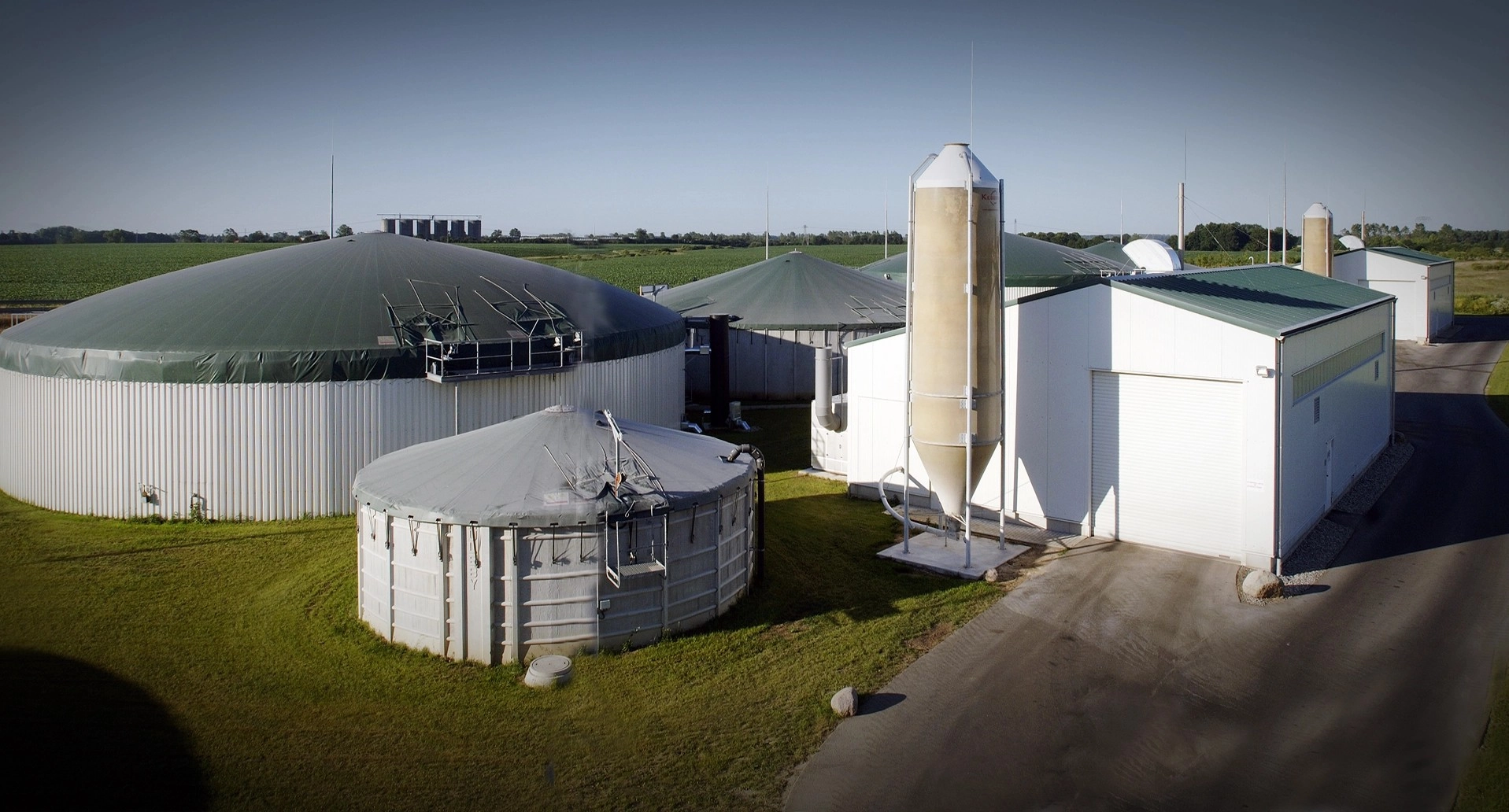
Biogas is produced through the anaerobic digestion (i.e. digestion without oxygen) of organic materials such as manure, sewage sludge or green waste. Examples of organisations that deal with this process include farmers, water agencies and waste processors. Biogas mainly consists of methane (CH₄), which can be used as a fuel. The advantage of biogas is that the methane it contains is not fossil-based, as is the case with natural gas, but is derived from biomass. This makes biogas a renewable fuel. Even if an organisation does not intend to make use of biogas, it is often produced naturally as a by-product of biological processes.
Does an organisation need to report on biogas?
If biogas is not captured, methane can escape into the atmosphere. In that case, the organisation is required to report these emissions (see the article on non-CO₂ greenhouse gases). Methane has a global warming potential approximately 27 times higher than CO₂, which means that it warms the atmosphere up 27 times faster than carbon dioxide. Capturing and using biogas therefore has a dual benefit: it prevents methane from escaping and allows it to be used to replace fossil fuels.
When does biogas become green gas?
A disadvantage of raw biogas is that, in addition to combustible methane, it contains significant amounts of non-combustible or undesirable substances such as CO₂, water vapour and ammonia. Although biogas can be used directly to generate electricity and heat (for example by water agencies), it is often first upgraded, by removing these other components. After this treatment process, the gas has the same composition as natural gas and is referred to as green gas.
Can green gas be traced within the gas grid?
Because green gas has exactly the same properties as natural gas, it is usually put into the national gas grid. From that moment onwards, the system functions in the same way as for green electricity: just as it is physically impossible to distinguish between grey and green electricity on the electricity grid, it is no longer possible to distinguish between natural gas and green gas within the gas grid. After all, there is only one integrated system.
How do Guarantees of Origin (GoOs) for gas work?
For this reason, most European countries operate a system of Guarantees of Origin (GoOs) for both green electricity and green gas. Through these GoOs, a purchaser of green gas receives assurance that an equivalent volume of green gas has been put into the gas grid. It is also important that the country in which the green gas is produced is the same as the country in which it is consumed (as is the case for green electricity). In the Netherlands, the GoO register for green gas and green electricity is managed by VertiCer, a government body. In Belgium, this is carried out by, among others, the Flemish Utilities Regulator and CWaPE in Wallonia.
How can I get started with GoOs?
Purchasers of green gas can either apply for an account in the relevant register themselves or arrange the administration through their energy supplier. For most organisations, the latter option is the most practical. The energy supplier must demonstrate that the correct volumes have been recorded as consumed in the register and allocated to the specific customer (for example by referencing this on the invoice). The national regulator (for example the Market and Consumer Authority (ACM) in the Netherlands) oversees this process. For the CO₂ Performance Ladder, compliance is verified by the auditor.
Should I aim to use biogas and green gas for the CO₂ Performance Ladder?
Organisations certified under the CO₂ Performance Ladder are, by definition, required to work on CO₂ reduction. Switching to green gas can be a meaningful measure for organisations that still use natural gas, as it reduces their direct emissions (Scope 1).
Other Influencable Emissions (OIE)
New in version 4.0 is the requirement for organisations to address non-CO₂ greenhouse gases and Other Influencable Emissions (OIE). As mentioned earlier, this is relevant, for example, for a water agency that would otherwise allow biogas to escape and therefore has to report methane emissions (a non-CO₂ greenhouse gas). Preventing methane from escaping is already a positive measure. It becomes even more beneficial if the organisation upgrades the biogas to green gas and sells it to a party that would otherwise have purchased natural gas. In that case, this qualifies as avoided emissions, a category within OIE. If the water authority uses the biogas itself, the CO₂ released during combustion must be reported as biogenic emissions, another category within OIE.
Which CO₂ emission factors should I use for green gas?
An organisation that produces and uses biogas directly, such as a water authority, in most cases already monitors the amount of carbon involved. Many emission factor databases provide specific factors for green gas. This also applies to the databases prescribed by the CO₂ Performance Ladder in the Netherlands and Belgium. It is important to select an emission factor that is as accurate and complete as possible and that corresponds closely to the source indicated on the Guarantee of Origin.
Can I use CO₂-compensated gas for the Ladder?
Some suppliers offer ‘CO₂-compensated’ gas. This is fundamentally different from green gas and does not count towards the CO₂ Performance Ladder. In practice, such gas is treated as ordinary natural gas. The distinction lies in the fact that CO₂-compensated gas involves the purchase of carbon credits on the (inter)national market to offset the emissions associated with natural gas consumption. This does not alter the physical origin of the gas itself.
For the exact requirements regarding green gas, please refer to requirements 1.A.2-1, 2.A.2-1 or 3.A.2-1 in Handbook 4.0 (or paragraph 5.2.2.1 in Handbook 3.1). If you have any further questions, please contact us.
Read more:
Non-CO₂ greenhouse gases included in CO₂ Performance Ladder