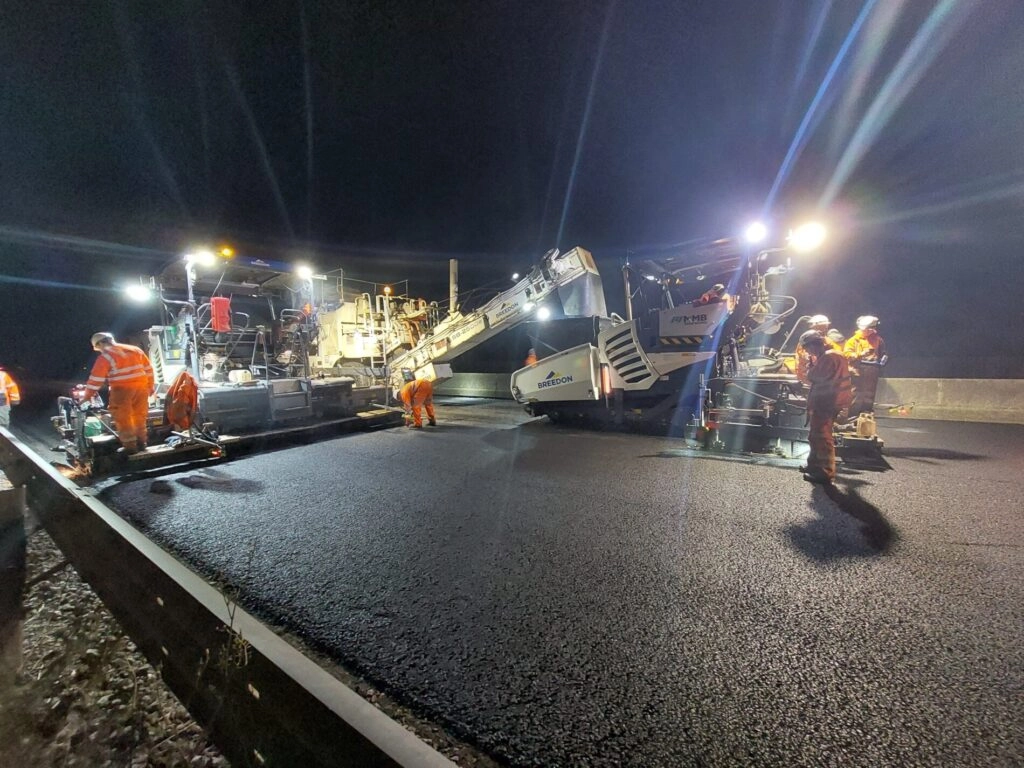
The M4/N4 pavement renewal in Ireland shows what happens when a procuring authority uses the CO₂ Performance Ladder consistently: measurable carbon savings, supply-chain collaboration, and material innovation.
When the first Ladder project in Ireland delivered a 21% CO₂ reduction in 2024, Transport Infrastructure Ireland (TII) decided to scale up. The Ladder is now embedded as a low-carbon procurement criterion across all of TII’s motorway maintenance contracts – making Ireland one of the first countries outside the Netherlands and Belgium to use the instrument structurally.
The M4/N4 Pavement Renewal Scheme, completed in autumn 2025, is the latest project to demonstrate the Ladder’s impact. It illustrates four effects that research consistently links to the use of the Ladder in procurement:
- stimulating significant, measurable carbon savings
- enabling structured dialogue between procuring authority and contractor
- supporting behavioural change within organisations
- encouraging material innovation
The project
The M4/N4 scheme involved replacing 9.4 km of road surface near Killucan in central Ireland. TII included the CO₂ Performance Ladder as an award criterion in the tender, granting a tiered notional discount based on tenderers’ CO₂ ambition level.
Jons Civil Engineering, the first company to achieve Level 4 certification on the CO₂ Performance Ladder in Ireland and the UK, executed the project. Working with subcontractor Breedon Group, Jons developed a detailed low-carbon project plan – a direct result of the structured dialogue the Ladder creates between client, contractor, and supply chain.
Low-carbon measures driven by the Ladder
Thanks to the Ladder’s framework of structured dialogue and continuous improvement, TII and Jons agreed on a set of innovative and impactful measures:
- Reclaimed asphalt pavement (RAP): A 510-metre trial section incorporated 15% RAP into the surface course, reducing the demand for virgin materials and promoting circularity alongside CO₂ reduction.
- Warm mix asphalt: The contractor switched from traditional hot mix to warm mix asphalt, cutting energy use and emissions during production.
- Structural monitoring and reporting: Project emissions were systematically tracked, enabling evidence-based evaluation of each measure’s contribution.
Results
The RAP trial section delivered a reduction of more than 9 kg CO₂ equivalent (CO₂e) per tonne of asphalt produced – an 11% reduction relative to the standard mix. Over the 501 tonnes of asphalt laid in the trial, this translated to approximately 4.7 tonnes of CO₂e saved.
These are the results from the trial section alone. The full environmental impact of the adopted methods across the wider project is still being evaluated by TII and the contractors, with a focus on long-term durability and performance.
What this project shows about the Ladder
The M4/N4 project confirms a pattern seen across hundreds of Ladder projects in the Netherlands and Belgium: when a procuring authority embeds the CO₂ Performance Ladder in its tenders, it can unlock low-carbon innovation that would not otherwise happen. The Ladder’s structured approach – combining a financial incentive with requirements for insight, reduction targets, transparency, and supply-chain collaboration – gives both clients and contractors a clear framework to act.
With TII now applying the Ladder across all motorway maintenance contracts, Ireland is making low-carbon procurement a standard part of infrastructure delivery – joining a growing international movement of public authorities using the Ladder to turn climate ambitions into measurable results.
A version of this case study first appeared on the website of the Irish Green Building Council, which coordinates the CO₂ Performance Ladder in Ireland in collaboration with SKAO.
Interested in procuring with the CO₂ Performance Ladder?