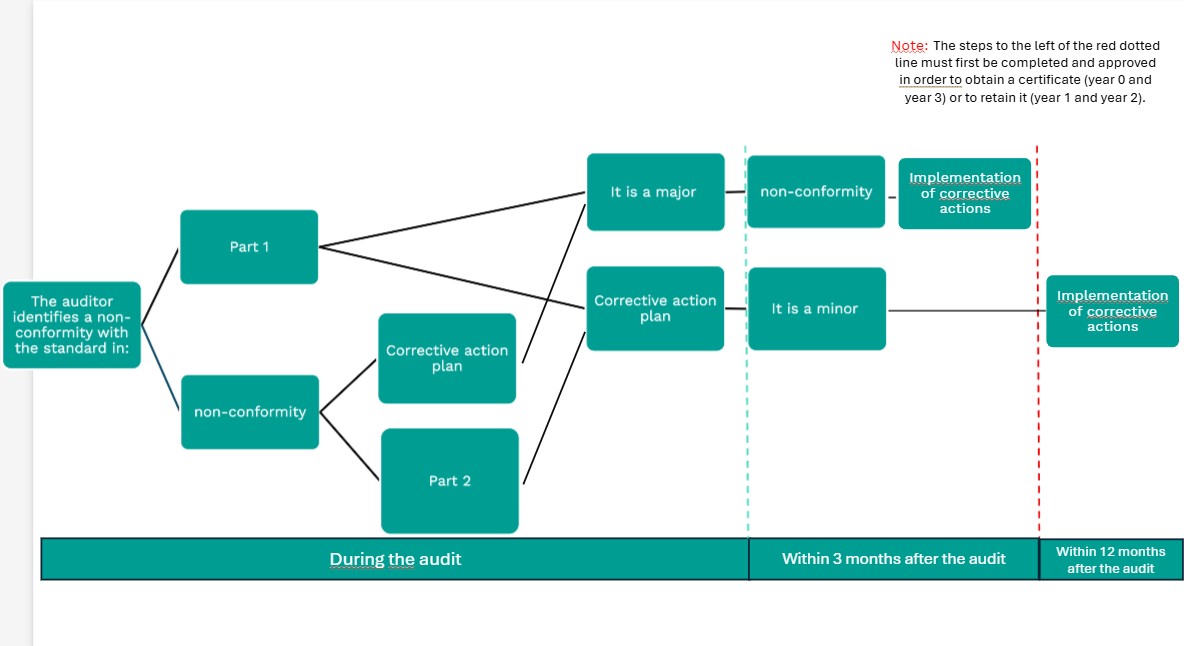
Harmonisation Act: organisations must submit a plan within 3 months to address minor non-conformities
SKAO published a new Harmonisation Act relating to CO₂ Performance Ladder 4.0. This Harmonisation Act concerns the period within which organisations must be able to submit a plan to address minor non-conformities. This period has been shortened from 12 months to 3 months. The period allowed for actually implementing the corrective measures remains unchanged: this may still take place up to 12 months after the audit.
Earlier submission is more effective and more common practice
A certification body (CB) only issues a CO₂ Performance Ladder Certificate if an organisation meets the requirements of a specific level of the Handbook. If this is not (fully) the case, the auditor identifies so-called non-conformities. These may be major or minor non-conformities. For minor non-conformities, CO₂ Performance Ladder 4.0 states that the organisation has until the next audit (approximately one year) to draw up and implement a corrective action plan. It is more effective (as it allows the CB to assess the plan) and more common practice (including under ISO/IEC 17021-1) to prepare and submit the corrective action plan at an earlier stage.
Implementation of the plan may take place later
Organisations must therefore draw up and submit a corrective action plan to the CB within 3 months after a minor non-conformity has been identified. The deadline for implementing the plan remains unchanged (before the next audit), meaning that the minor non-conformity does not need to be resolved within 3 months.
About Harmonisation Acts
In some cases, a passage in the Handbook may require further clarification, or there may be evolving insight into how a requirement should be interpreted. In such cases, an additional rule is drawn up for that passage, which we refer to as a ‘Harmonisation Act’. The Handbook is normative, and this also applies to these harmonisation acts that have been added at a later stage.
View Harmonisation Act 2The decision tree shows the timeframe within which organisations must start correcting deviations. For minor deviations, the timeframe within which the plan must be submitted has been adjusted from 12 months to 3 months.
A new study by the Utrecht University Centre for Public Procurement (UUCePP) shows a clear association between the use of the CO₂ Performance Ladder in public construction tenders and lower CO₂ emissions at the municipal level. The research — carried out as part of an EU project funded by the…
Public sector organisations demonstrably procure more sustainably when their tenders are visible. This is the conclusion of a large-scale study by Utrecht University, which analysed over 1,300 Dutch tenders using the Sustainable Procurement Self-Assessment Tool (MVI-ZET). Transparency acts as a driver for applying sustainability criteria such as the CO₂ Performance Ladder.
Newsletter erhalten?
Möchten Sie alle zwei Monate Updates, Projektbeispiele und Neuigkeiten über die CO2 Performance Ladder erhalten? Abonnieren Sie unseren Newsletter!
„*“ zeigt erforderliche Felder an
Manage Consent
To provide the best experiences, we use technologies like cookies to store and/or access device information. Consenting to these technologies will allow us to process data such as browsing behavior or unique IDs on this site. Not consenting or withdrawing consent, may adversely affect certain features and functions.
Functional
Always active
The technical storage or access is strictly necessary for the legitimate purpose of enabling the use of a specific service explicitly requested by the subscriber or user, or for the sole purpose of carrying out the transmission of a communication over an electronic communications network.
Preferences
The technical storage or access is necessary for the legitimate purpose of storing preferences that are not requested by the subscriber or user.
Statistics
The technical storage or access that is used exclusively for statistical purposes.The technical storage or access that is used exclusively for anonymous statistical purposes. Without a subpoena, voluntary compliance on the part of your Internet Service Provider, or additional records from a third party, information stored or retrieved for this purpose alone cannot usually be used to identify you.
Marketing
The technical storage or access is required to create user profiles to send advertising, or to track the user on a website or across several websites for similar marketing purposes.