Arcadis first engineering consultancy to be certified at step 3 of Ladder 4.0
The drawing board can be the most influential place to drive sustainability in construction, as Arcadis demonstrates. With ambitious sustainability goals, the company became the first engineering consultancy to be certified at step 3 of version 4.0 of the CO₂ Performance Ladder at the end of 2025. Nevertheless, the journey towards zero CO₂ emissions within its own organisation and across the value chain by 2050 still presents major challenges – particularly when it comes to mapping emissions from value chain partners (Scope 3 and OIEs). “If you want to stay ahead of the curve, you shouldn’t choose the easiest route.”
As a designer of bridges, roads, tunnels and buildings among others, Arcadis operates at the very start of the construction value chain. From this position, the Dutch multinational can significantly steer construction projects towards more sustainable delivery, explains Sophie Hanekamp, Sustainable Operations Manager at Arcadis Netherlands. “The built environment accounts for around 40 per cent of CO₂ emissions in the Netherlands. If we continue advising clients to build mainly with steel and concrete, little will change. But if, through a design or advisory role, we demonstrate alternatives such as biobased materials, circular use of materials or clean technologies, this can have a major impact on reducing emissions.”
“When we demonstrate in a design or advisory project which alternatives are available — such as biobased materials, circular use of materials or clean technologies – this can have a major impact on reducing emissions.”
Sophie Hanekamp, Sustainable Operations Manager at Arcadis Netherlands
Going the extra mile
As a driver of sustainability, Arcadis also wants to be a frontrunner in CO₂ reduction itself, says Hanekamp. “We are not only working on future-proofing the built environment and infrastructure; as an organisation we also want to go the extra mile. That is why we have been certified on the CO₂ Performance Ladder since 2012. In terms of ambition, the Ladder goes further than, for example, ISO standards and legislation such as the CSRD. It helps us to critically assess our impact both within and beyond the organisation and to engage clients in meaningful conversations about sustainability. At the same time, Ladder certification gives us an advantage when tendering, if the Ladder is used as an award criterion.”
That is why we have been certified on the CO₂ Performance Ladder since 2012. In terms of ambition, the Ladder goes further than, for example, ISO standards and legislation such as the CSRD.
Getting started with 4.0
To remain at the forefront, Arcadis began working with version 4.0 of the CO₂ Performance Ladder at the start of 2025 – immediately after its launch. According to Hanekamp, the revised version came at exactly the right time. “With the previous version, we noticed that the challenge had diminished somewhat. We were meeting targets relatively easily and had been certified at the highest level for quite some time. As a result, it also became harder to differentiate ourselves on sustainability in tenders. The new handbook is far more ambitious and therefore presents new challenges – especially at the highest step, step 3. Once we started looking into the requirements, it was immediately clear that it would not be easy. But if you want to stay ahead of the curve, you shouldn’t choose the easiest route. We quickly gained commitment from our executive board and then set to work on version 4.0.”
Developing a Climate Transition Plan
One of the new elements of CO₂ Performance Ladder 4.0 is the requirement to develop a Climate Transition Plan. For step 3, this obliges organisations to map out a pathway to zero CO₂ emissions by 2050 within their organisational boundaries and across the value chain. Hanekamp explains: “In the context of the CSRD, we had already developed such a plan for Arcadis’s international organisation. For the Ladder, we mainly needed to translate and further specify that document for the Dutch context. To do so, we looked at climate challenges in the Netherlands and the Royal Netherlands Meteorological Institute’s climate scenarios, linking these to our own targets up to 2030. By that year, we aim to be net-zero at organisational level. Beyond that, the route towards zero emissions by 2050 is still relatively open. We know the end goal, but how we get there depends on many factors. How will carbon capture develop, for example, or the market for biobased construction materials? Sometimes a solution turns out not to work, or technologies re-emerge that were previously written off.”
Measures for scope 1 and 2
When it comes to measures within scope 1 and 2, Hanekamp expects little change for Arcadis in the coming years. “Our main impact within these scopes lies in mobility and energy use in our offices. In terms of mobility, we have made major strides in recent years in electrifying our lease fleet. We are now close to 80 per cent electric vehicles, and by 2028 we aim to reach 100 per cent. In addition, all employees receive an NS Business Card for the Dutch public transport network, which they are also allowed to use privately, and we reimburse walking and cycling kilometres to encourage healthy and sustainable travel. Our influence on making our offices more sustainable is somewhat limited, as we do not own them. However, in discussions with building owners we try to steer as much as possible towards sustainability in order to make all our offices Paris-proof. In Arnhem, we recently moved to a more sustainable building. In Amsterdam, we are currently developing a new head office, which will be the most sustainable building in the Zuidas district.”
Impact on the value chain
Much more than in the previous version, version 4.0 of the Ladder focuses on making an impact across the value chain. This means that, for the top two steps, organisations must qualitatively and quantitatively map the emissions of parties they work with, such as suppliers, clients and project partners. Hanekamp says: “The value chain responsibility in the new handbook is a real improvement. Under the previous version, we also had to carry out a chain analysis, but it was far more limited. Having to take additional steps now is only a good thing. The obligation to come up with concrete figures ensures that we engage even more with our partners about sustainability. This also strengthens collaboration and allows us to explore how we can support one another.”
“The supply chain responsibility set out in the new handbook is a real improvement. Under the previous version, we also had to carry out a supply chain analysis, but it was far more limited. The fact that we are now required to take additional steps is only a positive development.”
The challenge of collecting data
At the same time, Hanekamp acknowledges that mapping value chain emissions is also the most challenging aspect. “For scope 3, we are on the right track. For example, we receive insights from RENEWI into the emissions associated with our waste, and we are increasingly able to translate the carbon footprint of purchased products using emission factors. But when it comes to Other Influenceable Emissions (OIEs), we are still very much searching for the right approach. We carry out thousands of projects with a wide range of parties from different sectors. You need to persuade them to share data. Then you have to determine which data to include. Do you take the emissions of the entire project, or only the part in which you are involved? And how do you calculate comparative emissions? Only once we have more concrete figures can we set targets for a reduction pathway towards 2050. In the coming years, we will largely have to rely on assumptions and estimates.”
Influence on projects
Despite the challenges of expressing value chain impact in figures, Arcadis actively seeks to influence partners wherever possible to reduce their CO₂ emissions, Hanekamp emphasises. “We do this in many different ways. For instance, we recently worked on a project with NS (the Dutch railway company) in which 1,100 windows from old intercity trains were reused in the wall of a wheelset lathe pit – a train maintenance facility. This circular solution saved a significant amount of concrete. Another way we make an impact is through project selection. For example, we do not participate in the exploration or extraction of new oil or gas fields, but we do work on decommissioning existing installations and making processes more sustainable. We do not reject projects lightly – we are, after all, a listed company – but we adhere as closely as possible to our sustainability principles.”
Engaging in dialogue on sustainability
To steer projects towards sustainable solutions, Arcadis has developed its own training programme: Sustainability in Six Steps. Hanekamp explains: “Through this training, we equip our colleagues to engage clients in conversations about sustainability. How do you approach this, and how do you convince them to choose, for example, a biobased or circular solution? This can be quite challenging, as cost has traditionally been the decisive factor. Sustainability goes beyond CO₂ reduction alone – It also encompasses aspects such as biodiversity, health and climate adaptation. The new version of the Ladder also embraces this broader perspective. Following the revision of the Ladder, we recently updated the training. We now place even more emphasis on making solid agreements at project level for CO₂ reduction to maximise impact. We also show how to integrate Ladder commitments into the project plan and communication plan. The knowledge and experience we gain through the CO₂ Performance Ladder are also shared with other organisations. In this way, we support clients and partners in developing climate strategies and achieving their own certification.”
Step 3 certificate, version 4.0
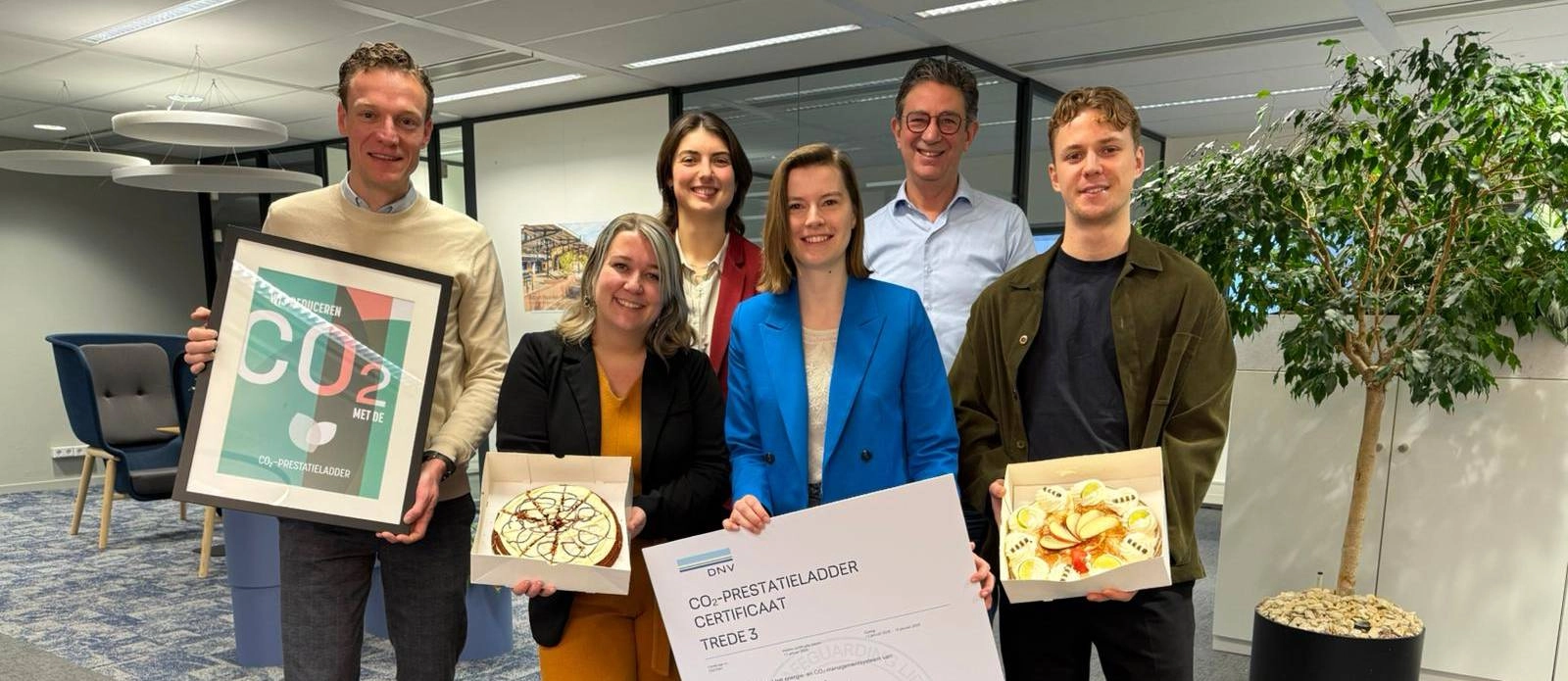
In December 2025, Arcadis became the first engineering consultancy to receive a certificate at step 3 of Ladder version 4.0. Hanekamp is immensely proud of this milestone. “We worked hard to achieve this. At times, we had to check in with SKAO or our certification body (CB) to ensure we were interpreting requirements correctly and heading in the right direction. Some aspects allow for a degree of flexibility, which is helpful – but you don’t want to take a wrong turn. It is also valuable for SKAO and the certification bodies to understand the challenges organisations face with the new version, particularly when it comes to OIEs, where much still needs to be researched. But now that we have started, we have a solid foundation on which to build. It is also great for our employees that we have already achieved this – although for some it takes a bit of getting used to that we have moved from level 5 to step 3. It may sound like a step backwards, when in fact we are performing better than ever.”
Barneveld has become one of the first municipalities certified at Step 1 of the CO2 Performance Ladder version 4.0. The local authority in Gelderland is strongly committed to reducing and greening its energy consumption, including through the procurement of locally generated energy. By establishing and supporting sustainable energy initiatives, Barneveld aims not only to reduce CO2 emissions, but also to stimulate the local economy…
From pilot project to full certification In 2024 the first Irish pilot project with the CO₂ Performance Ladder was completed: Jons Civil Engineering successfully delivered a motorway resurfacing project with an impressive 21% CO₂ reduction. That milestone demonstrated that the Ladder, widely used in the Netherlands and Belgium, also…
Newsletter erhalten?
Möchten Sie alle zwei Monate Updates, Projektbeispiele und Neuigkeiten über die CO2 Performance Ladder erhalten? Abonnieren Sie unseren Newsletter!
„*“ zeigt erforderliche Felder an
Manage Consent
To provide the best experiences, we use technologies like cookies to store and/or access device information. Consenting to these technologies will allow us to process data such as browsing behavior or unique IDs on this site. Not consenting or withdrawing consent, may adversely affect certain features and functions.
Functional
Always active
The technical storage or access is strictly necessary for the legitimate purpose of enabling the use of a specific service explicitly requested by the subscriber or user, or for the sole purpose of carrying out the transmission of a communication over an electronic communications network.
Preferences
The technical storage or access is necessary for the legitimate purpose of storing preferences that are not requested by the subscriber or user.
Statistics
The technical storage or access that is used exclusively for statistical purposes.The technical storage or access that is used exclusively for anonymous statistical purposes. Without a subpoena, voluntary compliance on the part of your Internet Service Provider, or additional records from a third party, information stored or retrieved for this purpose alone cannot usually be used to identify you.
Marketing
The technical storage or access is required to create user profiles to send advertising, or to track the user on a website or across several websites for similar marketing purposes.